Showing posts with label Dairy. Show all posts

Friday, December 16, 2011

Irish Cream

Cream, rich as an Irish brogue;
Coffee, strong as a friendly hand;
Sugar, sweet as the tongue of a rogue;
Whiskey, smooth as the wit of the land.

-a traditional toast accompanying Irish coffee


There are two drinks that we go through in unholy quantities this time of year.  The first without question is rum, as it is used in all kinds of preserves, baking, and cocktails.  The second is Irish cream, consumed on its own, or diluted with a bit of milk or coffee.

For years my standby has been Bailey's, but this year I decided to make my own.

Irish cream is comprised of cream, sugar, and Irish whiskey, usually but not always flavoured with coffee.  It is around 20% alcohol by volume, and has a rich, viscous mouthfeel.  It is basically an Irish coffee (whiskey, sugar, and cream stirred into a cup of coffee) with the ingredients in different proportions.

If you plan on consuming Irish cream in coffee, there's probably not much point in flavouring it with coffee.  I'm after a drink to be enjoyed on its own, so I've included strong coffee in my recipe.

I've come across some recipes online that use condensed milk to approximate the thickness of commercial brands.  The truth is that it's not the thickness of condensed milk that gives the final drink a rich mouthfeel, it's the sugar content.  Sugary liquids have a high specific gravity and give the impression of viscosity on the palate.  Granulated sugar and cream therefore work just as well as condensed milk.

The following recipe is a reasonable facsimile of commercial brands, though with a more distinct coffee flavour.  Obviously you can adjust the whiskey content to suit your taste.


Irish Cream
a working recipe

Ingredients
  • 4 egg yolks
  • 50 g granulated sugar
  • 1 pinch kosher salt
  • 70 mL strong, high quality coffee, chilled
  • 33 mL heavy cream
  • 140 mL Irish whiskey, preferreably Jameson's
  • 1.25 mL vanilla extract
Procedure
  1. Whisk the sugar and salt into the egg yolks.
  2. Whisk in the remaining ingredients.  Let stand in the fridge overnight.

Thursday, December 15, 2011

Towards a Theory of Eggnog

 
For the last two years I've been using this method to make eggnog:
  • whisk egg yolks with some sugar until pale and foamy
  • whisk egg whites with some sugar until soft peaks form
  • fold the two egg foams together and stir into milk and cream
  • add rum and nutmeg
The problem with this method, first of all, is that if it sits for even five minutes, the eggy foams separate from the milk and cream. I wouldn't mind a bit of head on the nog, but the foams make up about 90% of the volume.  Even during the brief moments in which all the ingredients are properly incorporated, the light and airy texture of the nog doesn't seem appropriately robust and nourishing.

So I've done some experimenting with my nog method.  First I tried simply whisking all the ingredients together, by-passing the egg separation and foaming.  This version also separated, which absolutely baffles me, as whisked eggs don't separate if you leave them in the fridge.

Out of sheer curiosity I tried cooking out a mixture of milk, cream, and yolks, à la crème anglaise.  It was a bit thick, even once thinned with rum, but before repeating the process with a lower yolk content I decided that the cooked-egg taste is also inappropriate to the ideal nog.

For now I've settled on using just yolks.  Somehow this isn't as satisfying a concept as drinking whole eggs, but it's tasty.


Eggnog: A Working Recipe

Ingredients
  • 4 oz egg yolks
  • 8 oz granulated sugar
  • 1 pinch kosher salt
  • 16 fl oz whole milk
  • 4 fl oz heavy cream
  • 16 fl oz golden rum, I use Appleton's
  • nutmeg to taste
Procedure
  1. Whisk sugar and salt into egg yolks.
  2. Add all remaining ingredients and whisk to combine.

The final important piece of information I came across this year was that properly boozed nog can be made well, well before consumption, and aged in the fridge.  Michael Ruhlman has successfully aged eggnog for two years, if you can believe it.

I put up a large jar of eggnog on the first of December, with the intention of cracking it open on the solstice or Christmas.  It lasted maybe fours days in the fridge.  A replacement batch is currently ripening on the bottom shelf.

Wednesday, May 26, 2010

Dairy Week - Day 6: Fresh Mozzarella

I recently looked up "mozzarella" in Larousse, and found the following descriptions:
  • "a fresh cheese, springy and white"
  • "kept in salted water or whey, shaped into balls or loaves of varying size"
This sounded utterly unlike any mozzarella I've had before. Turns out there are two types of mozzarella in this world: the traditional fresh mozzarella, described above, and the American low-moisture mozzarella, which includes the familiar white bricks at the grocery store. Traditional mozzarella belongs to a class of cheeses called pasta filata, which means "spun paste" or "spun curds". The curds are heated, then stretched repeatedly to develop an elastic texture in the finished cheese. Other cheeses made by this method are provolone, scamorza, and caciocavallo.

I later found out that I have had traditional, fresh mozzarella, in the form of bocconcini, which is not a distinct type of cheese, but rather a specific shape ("bite-sized") of mozzarella. The process of cutting and shaping pasta filata is called mozzatura. Besides bocconcini, there are other traditional shapes, like trecce (braids) and nodini (little knots).

There are hundreds of pages on the internet that explain how to make fresh mozzarella at home. Most of these use citric acid to acidify the milk. I am using bacterial cultures from Danlac, which are supposed to result in a more aromatic, spongy cheese.
As with the yogurt earlier this week, I was working from the cursory, quasi-industrial specifications supplied by Danlac. After two botched attempts, I finally made good mozzarella with the help of this instructive demonstration by Fias Co Farm in Michigan.


Making Mozzarella with Danlac Bacterial Cultures

The following is for 4L of whole milk.

Heat the milk to 34°C. This is the ideal incubation temperature for the cultures.

Add a pinch (about 1/8 tsp) of the bacterial cultures, Choozit TM 81. Stir briskly. Hold at 34°C until the pH drops to 6.5, about one hour. I held my milk in a warm water bath to stabilize the temperature.

Add roughly 1/10 of a packet of Valiren microbial cheese rennet (one packet is for 50L of milk). Stir the mixture. The rennet will coagulate the proteins in the milk to form curds. The ideal temperature for the rennet is the same as for the bacterial culture, 34°C. Coagulation is complete when you obtain a "clean break". To perform a clean break test, stick your finger in the pot and pull it through the curd a couple inches. The curd should separate cleanly, and clear whey should pool in the crevice (see photo, below). My coagulation times ranged from 1.5 to 2 hours.

Testing the mozzarella curd for a clean break
Cut the curd into small pieces, about 2-2.5cm, with a sharp knife. This releases whey from within the curd, making for less moisture in the finished cheese. Let the curds rest for 5-10 minutes.

Hold the mixture at 34°C for about an hour, stirring occasionally during the first half hour. This stage gives the bacteria time to create more lactic acid. The pH must fall to around 5.0 or the curd will not stretch properly when it comes time to make the pasta filata. While stirring, the curds will shrink and harden somewhat as they release their whey, but they should remain moist, gel-like, and delicate.

Pour the curds and whey through cheesecloth. Strain until no more whey drips through the cloth. While straining, the curds will knit back together to form a homogeneous mass.

Straining the curds and whey
We now have cheese, but we need to make it into pasta filata. By heating and stretching the cheese we rid the curd of excess whey and give the final product its characteristic texture. You can heat the cheese either in a microwave, or in a pot of simmering water held around 70°C.

Once heated the cheese should stretch under its own weight. You will see whey run out of the cheese as it stretches. When the cheese cools and becomes less pliable, reheat it by your chosen method. Now is the best time to add salt.

Pasta filata: the mozzarella stretching under its own weight
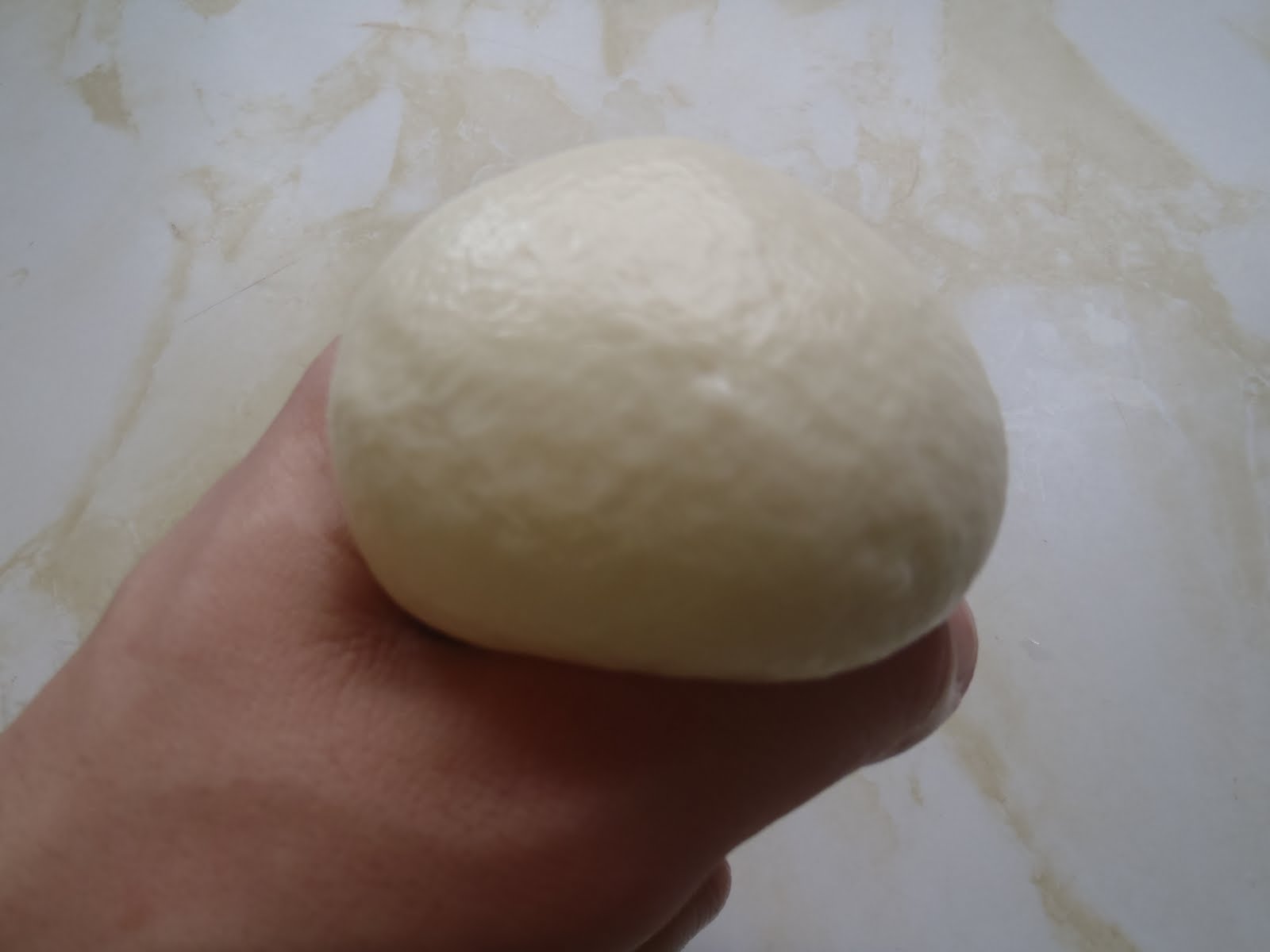
The last step is mozzatura, the shaping of the pasta filata. The most common shape is the sphere. Simply squeeze a section of the cheese so that it bulges out of your hand. Tuck the free end remaining in your hand into the bottom of the sphere.

Mozzatura: forming the mozzarella into spheres
To make bocconcini, use plastic wrap to roll the heated cheese into a log about one inch in diameter. Tie a knot of twine every inch, and refrigerate for eight hours. Cut the twine and unwrap the cheese. Separate the bocconcini and marinate in olive oil.

Mozzatura: rolling the mozzarella into a log to make bocconcini
Mozzatura: the wrapped and tied bocconcini
[Update May 28, 2010: Here's a shot of the margherita pizza we made with the mozzarella.]


Dairy Week - Day 5: Yogurt

Goat's milk from Fairwinds Farm of Fort Macleod, AlbertaMy ideal yogurt is Greek yogurt, which is thick, rich, flavourful, and made of sheep's milk. Unable to find whole sheep's milk, I'm experimenting with goat's milk from Fairwinds Farm of Fort Macleod, Alberta, as it is fattier (and just more Greek) than cow's milk.

There are two ways to make yogurt at home. The first is to add a small amount of commercial yogurt containing active cultures to milk. The second is to use pure bacterial cultures. Regardless of which method you use, the process is basically the same.


Danlac Starter Kit

I eventually want to make cheese with pure bacterial cultures. I contacted Danlac in Airdrie, and ordered a
starter kit containing several doses of rennet and cultures for yogurt, mozzarella, and feta.

The rennet and cultures were put in an envelope and mailed to me. The recipes for yogurt, feta, and mozzarella were e-mailed. Danlac's motto is "Serving the food industry," not "Serving the interested individual," and the recipes reflect that fact: they're more like industrial specifications than recipes. There are values measured in pounds per square inch, and mention of back pressure valves and plant conditions. All the relevant temperatures and times are listed, but to understand exactly how the process might be done in a kitchen, I consulted a few of the several hundred sources on the internet.


Yogurt: A First Attempt

Mise en Place

First, in my kitchen sinks, I set up an ice bath and a
45°C warm water bath. The first is for cooling the hot milk, the second is for holding the milk at the bacteria's incubation temperature.

Water baths for controlling temperature while making yogurt at home
Next I measured out the yogurt cultures. The YO-MIX 601 packet I received contains freeze-dried pellets of the two most common cultures used in yogurt production: Lactobacillus bulgaricus, and Streptococcus thermophilus. The problem is that the packet is designed to inoculate 500L of milk, and only weighs 7g. I wanted to inoculate 4L of milk, which means that I would need 0.0056g of yogurt cultures. Unfortunately, my weigh-scale is not that precise.

4L divided by 500L is 0.008.

I poured the bacteria onto a cutting board. Using a butter knife, I roughly divided the contents into five piles, then split one of the those piles into ten. I continued eye-balling smaller and smaller divisions until I had approximately eight thousandths of the original pile balanced on the end of my knife. It was about a pinch. Go figure. This is sure to be a huge source of inconsistencies between batches. I slid the rest of the pellets into a small ziploc and put them in the freezer, as per storage instructions on the packet.

A pinch of yogurt culture from a Danlac starter kit
Heat the Milk

The first step in making yogurt is heating the milk and holding it at 85°C for five minutes. Besides killing any micro-organisms in the milk (which is completely redundant if you're using pasteurized dairy), the heat induces a mysterious change in the milk proteins that helps them set properly once coagulated. I heated my milk plain and simple on my stove top.

Heating milk, the first step of making yogurt at home
Cool the Milk to Incubation Temperature

Next the milk is cooled to around 42°C, which is the ideal temperature for the bacterial cultures. I transferred my pot to the ice bath. After a couple minutes of stirring, it had dropped to 45°C.

Cooling the milk to the yogurt culture incubation temperature
Pitch Cultures and Incubate

With my milk temperature hovering around 42°C, I pitched my yogurt cultures. The milk now had to be held very close to this temperature for the next several hours.


There are lots of ideas on the internet for holding your milk at this awkward temperature, which too warm for room temperature, and too cool for an oven. I tried a simple system of thermal isolation. I tightly covered my stainless steel pot of milk, put it in the warm water bath at 45°, and covered the whole bath with plastic, and then with a thick towel. It made for a surprisingly closed system. My water bath lost a little more than 2°C every hour, at which time I would replace a few cups of water from the bath with hot water. Setting up the warm water bath in a large plastic cooler would probably work even better.

Thermally isolating the inoculated milk for optimal bacterial activity
Length of Incubation

In industry, fermentation is stopped when the pH of the milk is around 4.50. I don't have any titration tools, but my Danlac recipe provided the following rough time-line: if your milk is held at 42°C, it should take six hours to reach 4.50pH, and if your milk is held at 38°C, it should take eight and a half. Though you don't want lose heat or disturb the fermentation by opening the pot too often, thickness and taste are the best indicators of when to stop the process. I ended up letting mine incubate for a little over twelve hours. This was maybe because of the inaccuracy of my yogurt culture measurement, but also because my incubation temperature slipped into the cooler end of the acceptable spectrum for a few hours.


Stir

Next was by far the most ambiguous step in the recipe: "Treatment of coagulum according to desired consistency by: stirring, using back pressure valve for improving structure, homogenizing." I ignored the second and third options, as they didn't sound like tasks I could perform in my kitchen. I stirred my yogurt, mixing the loose curd structures and whey together.


Let the Yogurt Set

Finally I left the yogurt in the fridge for twenty four hours to cool and "form a solid network".


Results

The end product was acceptable, though a little thin. After straining with cheesecloth it was much closer to my thick, creamy Greek-style yogurt. It has a very pleasing, mild acidity that is rarely found in commercial products, which tend to be a little harsh.

I think next time I'm going to use 1/8 tsp of the yogurt cultures, about double what I added this time. Hopefully that will make the process run a bit quicker, and result in a thicker product.

Monday, May 24, 2010

Dairy Week - Day 4: Mascarpone, Queso Blanco, Lemon Ricotta

Today was devoted to playing with the simple formula (dairy) + (heat) + (acid) = (fresh cheese), that is, changing the dairy, acid, and amount of heat to manipulate the taste and texture of the finished cheese.


Homemade mascarponeMascarpone

Mascarpone is made from whole cream, and is usually curdled with lemon juice or straight citric acid. My recipe from the Culinary Institute of America's Garde Manger, Third Edition, called for tartaric acid (available at brewing supply stores), the taste of which took a distant backseat to the rich, buttery flavour of the cream.

  • 1.92L heavy cream
  • 1/2 tsp tartaric acid
Here are some brusque instructions. Heat cream to 80°C. Stir to prevent burning. Remove pot from heat and add acid. Once cream has formed curd, pour mixture into colander lined with cheesecloth. Refrigerate and let strain for twenty four hours.


Queso Blanco

Queso blanco, is another fresh cheese curdled with acid, cider vinegar in this case. While the pure citric and tartaric acids in the previous cheeses were almost undetectable, the cider vinegar makes its presence known. It has a crumbly texture, similar to ricotta.
  • 1.92L whole milk
  • 1 fl. oz cider vinegar
  • 2 tbsp kosher salt
Heat milk to 85°C. Stir to prevent burning. Slowly add vinegar and salt while stirring. Once milk has formed curd, remove pot from heat. Pour mixture into colander lined with cheesecloth. Refrigerate and let strain for one to three hours.


Cucumber salad with homemade lemon ricottaLemon Ricotta

The queso blanco produced a large quantity of fairly clear whey, and the mascarpone left a small amount of relatively thick, opaque whey. I combined the two to make a third batch of cheese, something approaching a traditional ricotta.

Loosely following a procedure for lemon cheese (intended for use with whole milk and cream, not whey...) I heated the whey mixture to 38°C, then slowly added lemon juice, stirring gently, until curds formed. I removed the pot from the heat, and let it sit at room temperature for a few hours. Then I strained the mixture for several hours to remove the whey.

I think the reason for the lower temperature in the recipe is this: since we want the lemon flavour to be fairly dominant, there will be lots of acid in the cheese, and therefore less heat is required to coagulate the proteins. With other cheeses like mascarpone, we don't want lots of acidity in the finished product, so we need more heat to help coagulate the proteins.

The lemon ricotta had very fine, moist grains, and (obviously...) a strong lemon flavour. I added a bit of lemon zest and salt after straining, and mixed it with sliced cucumbers, red onions, and a few cracks of black pepper for a simple salad.

Sunday, May 23, 2010

Dairy Week - Day 3: Whole Milk Ricotta

Homemade whole milk ricotta, spinach from the garden, onions, and proscuitto, all to be mixed into linguineI'm starting my foray into cheese-making with a few simple, fresh cheeses. First I'd like to cover the basics.


Cheese: A Blunt Introduction

Cheese is curdled dairy. "Curdling" is the coagulation of proteins. In cheese-making, heat, acid, and certain enzymes are used to coagulate the major protein in dairy, casein. Subjecting dairy to heat and acid or enzymes (or both) will separate the mixture into solid curds and liquid whey. The curds contain most of the protein, fat, and nutrients of the original dairy product. From an anthropological perspective, the principle benefit of cheese-making is that most of the energy and nutrients of the milk are solidified into a longer-lasting, easily-transported mass (that happens to taste amazing).

The whey, while mostly water, does retain a small part of the fat, protein, and nutrients, which brings us to today's project: ricotta.


Ricotta

Originally, ricotta cheese was made from the whey produced in the making of other cheeses. The word actually means "recooked". The most famous example is ricotta romana, which was once made from the whey of a hard ewe's-milk cheese called pecorino.
Later in the week I hope to have the whey from a few fresh cheeses, at which time I can try a traditional ricotta. In the meantime I wanted to try the ricotta procedure with whole milk. To my knowledge, all modern commercially-sold ricotta is made straight from whole or skimmed milk, which produces a richer cheese than the traditional whey.


Making Ricotta

The following recipe and procedure are paraphrased from the Culinary Institute of America's text Garde Manger, Third Edition. The only item required that is not in most homes is citric acid. Citric (also known as ascorbic) acid is sold in powder-form at brewing supply stores, and some grocery stores.

Ingredients
  • 960mL whole milk
  • 1/4 tsp citric acid
  • 1 tbsp water
  • 1/2 tsp salt
Procedure
  1. Dissolve citric acid in water. Combine milk, acid solution, and salt.
  2. Heat mixture to 85°C. Stir regularly to prevent burning.
  3. Once 85°C is reached, turn off heat. Let mixture sit for ten minutes.
  4. Pour into colander lined with damp cheese cloth. Refrigerate for one to three hours.
The shocking lesson of the day was how much milk it takes to make this cheese. Using almost a litre of whole milk, I ended up with about 150g of cheese. That was after one hour of draining the curd. I suspect that if I had drained for the full three hours I would have had well under 100g.

I'm looking at other recipes in the Garde Manger that use a similar process (heat whole milk, add acid, let sit, drain) but use different acids and have much, much higher yields. The queso blanco recipe, for instance, calls for cider vinegar, and yields about eight times more grams of cheese output per gram of whole milk input. Maybe citric acid has less "coagulating power" than other acids. More research required, obviously.

Yield aside
, the finished product had an exceptionally clean, mild taste. While the curd formed the characteristic granular clumps, it had a very smooth mouthfeel. Not rich or creamy, really, but smooth.

Saturday, May 22, 2010

Dairy Week - Day 2: Crème Fraîche

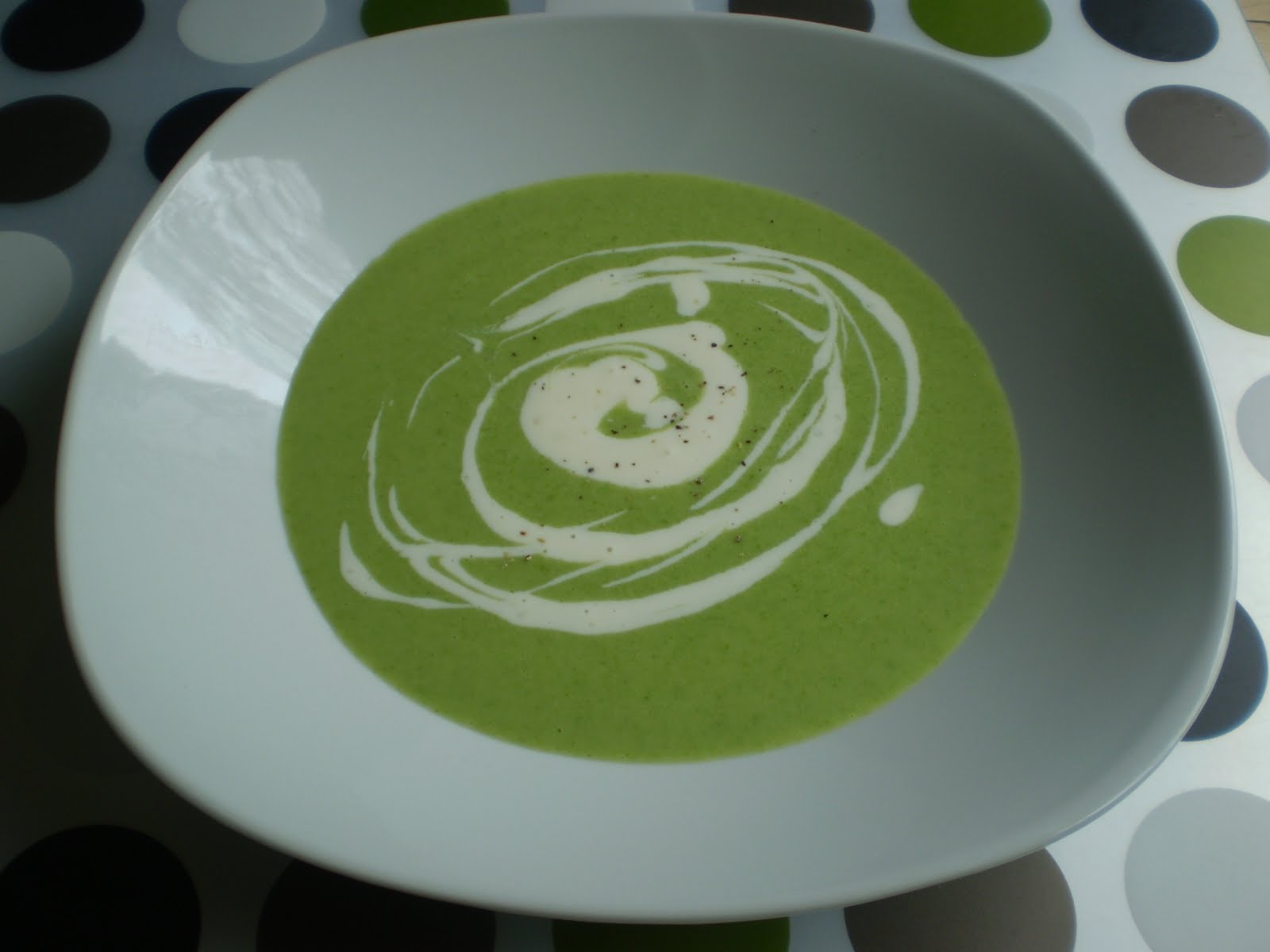
Cream of asparagus soup with creme fraiche.  The asparagus is from Edgar Farms of Innisfail, Alberta.Crème fraîche is similar to sour cream. In fact, they are made by the same process: inoculating dairy with a bacterial culture that converts lactose to lactic acid, which in turn coagulates the proteins in the dairy and thickens the mixture.

The major difference between
crème fraîche and sour cream is fat content. Crème fraîche is cultured whole cream, so is about 30% fat, while sour cream is made from leaner dairy products, and is usually around 15% fat. The added fat in crème fraîche gives it two advantages over sour cream. First, it has a more luxurious texture. Second, the fat tempers the acidity, making for a subtler and more rounded flavour.

Making Crème Fraîche at Home


Fresh dairy naturally contains the bacteria that would, over time, turn cream into crème fraîche. The traditional method of production would be to simply incubate that bacteria, and let nature take care of the rest. In the age of pasteurization, we must reintroduce this bacterial strain to the cream. There are several supermarket products that contain this strain. Buttermilk is one.

To make
crème fraîche at home, you need only stir one tablespoon of buttermilk into one cup of cream. Cover the mixture and leave it at room temperature for two days. Then refrigerate, which further thickens the mixture and arrests the bacterial growth.

I made my first batch this week. It tastes fantastic, but has small clumps of butterfat throughout. I suspect this is because I stirred the cream once during the two day incubation. I only gave it a few gentle turns to check the progress and redistribute the ingredients, but apparently this is completely unnecessary and compromises the heavenly texture of the finished product. Oops.


Crème fraîche is perfect for finishing cream soups, as it adds a very mild, pleasing acidity to cut the richness. It being the end of May, with Edgar Farms enjoying its brief few weeks at the Strathcona market, cream of asparagus soup seemed appropriate.

Friday, May 21, 2010

Dairy Week - Day 1: Butter

A bottle of Dutchmen Dairy creamThis coming week is Dairy Week.

Dairy Week was not established by Alberta Milk, or the Dairy Farmers of Canada. It was established by me, just now, and will be celebrated in my kitchen.


I have a bunch of dairy projects and recipes cluttering the back of my mind, and I've decided to perform some spring cleaning and do them all this week. I have one experiment planned for each of the next eight days. In preparation, I've stocked my fridge with cream, whole milk, and buttermilk from
Dutchmen Dairy of Sicamous, BC.

So, without further ado...


Dairy Week - Day 1: Butter


I'm starting with butter because it's the most common dairy product in my house, and is dead-simple to make, requiring only cream, a container with a good seal, and a bit of salt.


I think as children most of us were taken to historical sites like Fort Edmonton to learn how the settlers made wool and horseshoes and butter. Even so, I'll start at the beginning.


You make butter by agitating cream.


It works like this. The fat in cream is in tiny globs, each covered with a membrane that prevents the fat globs from joining together. When you agitate cream, you break these coverings, releasing the fat globs, which all rush out to join their fatty brethren and form a solid mass of butter.


To commence butter-production, fill your container half way with heavy cream. Add a pinch of salt, secure the lid, and start shaking. You don't have to strain yourself, just use a gentle shake that you can sustain for maybe ten minutes. After a while the cream will thicken: the contents will be noticeably less fluid, and there will be less sloshing. At this point you've simply introduced air into the liquid and made whipped cream:


The thickened cream: keep shaking...
Once whipped cream has formed, it's a little more difficult to keep the cream moving in the jar. Perform a couple minutes of aggressive shaking, which will separate the butterfat and buttermilk:


The butterfat and buttermilk, separate at last.
While the resulting liquid is technically buttermilk, it does not have the tanginess that we usually associate with buttermilk. Unpasteurized cream has bacteria that convert lactose (the main sugar in dairy products) to lactic acid. When making butter with unpasteurized cream, the resulting buttermilk slowly develops a tangy taste as the lactic acid accumulates. Since I am using pasteurized cream, there are no active cultures, and therefore no hope for acidity. My "buttermilk" is actually just skim milk.


(As a quick interjection, these days commercial buttermilk is actually pasteurized milk that has had the above-mentioned bacterial cultures reintroduced and incubated...)

The butterfat that has clumped together must now be worked to remove small pockets of buttermilk that remain within. When making such a small amount of butter, you can just use your hands. Knead the butter. You should see droplets of buttermilk come out.


At this point the butter is usually pressed into a mold to form the familiar bricks. Or in my case, hockey pucks:


The worked butterfat, pressed into a ramekin
My finished product has little to distinguish itself from store-bought butter, besides a slightly richer dairy flavour. It's very good, but the benefits aren't great enough to convince me to start churning cream for my daily supply of butter. (Maybe once I have my own cow...) It's still a good experiment to try once, if only for general knowledge and appreciation of this rich but humble staple.

Monday, June 15, 2009

Got Any Cheese?

As a boy raised on macaroni and cheese (every Friday night) and grilled cheese sandwiches (every Sunday afternoon), I knew that to get through this summer I would need to find some good local cheese-makers.

The starting point for my cheese-quest was an article by Jennifer Cockrall-King on local artisan cheese makers. Between the three producers listed there, and a couple others I had heard of through friends, I had a nice list with which to start:

  • Eyot Creek – near Leduc, gouda
  • Natricia – Ponoka, goat cheese
  • Leoni Grana – Camrose, parmesan
  • Edelweiss Foods – St. Albert, camembert
  • Sylvan Star – Red Deer, gouda and cheddar
  • Tiras – Camrose, specializing in Greek cheeses such as feta and kefalotiri
Working through this list, trying to acquire each cheese, I found that most of them are no longer being made. My research was conducted from the chair in which I now sit, reading out-dated webpages and dialing the phone numbers that I found on them. Not crack-shot journalism, to be sure, but there were a couple of good finds. Here are my notes:

Eyot Creek – If you Google Eyot Creek, you are presented with a slough of webpages concerning an E. coli outbreak from late 2002. The sicknesses were traced back to Eyot Creek farmstead cheeses that had been sold or given away at both the Strathcona and St. Albert farmers’ markets. I could find no information on Eyot Creek dated after the E. coli outbreak. I assumed the worst and crossed Eyot Creek from my list.

[Update: I just found an article in The Leduc Representative that says Eyot Creek stopped cheese production partly because of "cost prohibitive renovations recommended by Captial Health".]

Natricia – The above-mentioned Cockrall-King article said that this Ponoka goat cheese is available at Paddy’s International Cheese Shop. I went there and asked for it by name. The girl behind the counter said that they were currently “considering” carrying Natricia, but that they hadn’t decided yet. Most likely she had no idea what I was talking about. When I got home I called the number for Natricia from an antiquated Ponoka business listing, and got the private voice mail of a Ponoka couple. Also, the url I had for the alleged Natricia website was a dead-end. Strike two.

Leoni Grana – This parmesan from Camrose is also long gone. There is a brief explanation on a forum on The Edible Prairie.

Edelweiss – Contacting Edelweiss Foods Ltd, I got the peculiar feeling that I was calling a man at his private residence (the phrase, “How did you get this number?” came up). He said that, unfortunately, he is no longer able to make cheese.

Sylvan Star – This well-known, award winning cheese is available at Planet Organics. Sylvan Star specializes in gouda and cheddar, but they also make cheese curds, if you’re a stickler for authentic poutine.

Tiras – When I called the Camrose listing for Tiras Dairies, a woman answered and pronounced the word Tiras with some difficulty. I asked hesitantly if their cheese was available in Edmonton. Of course, she replied, and gave me a list of vendors, among them Hellas Food Importers, El Safadi Bros, and Omonia Foods.
A tub of Vlahos Greek Style Feta made by Tiras Dairies of Camrose, Alberta
As a pretentious philhellene, I would like to go on record and say that Tiras feta (marketed as Vlahos Greek Style Feta) is fantastic. Unlike rubbery super-market feta, Tiras is soft and creamy, while retaining the characteristic feta crumble. Also, if you buy it in a large enough quantity, it's cheaper by weight than good grocery store cheeses like Cracker Barrel.