Showing posts with label Seasonal. Show all posts

Friday, April 22, 2011

Easter Sunday: Food as Symbol


The food commonly eaten on Easter Sunday is rich in symbolism.  The ingredients and dishes are rooted in two traditions: the Jewish Passover dinner, or Seder, and the pagan springtime festival of renewal and fertility.  Easter food shows how these two traditions have combined to form our current concept of the holiday.


Bread and Wine

Growing up, Easter Sundays began with a church service that re-enacts the last supper of Christ, which was a Seder.  The first “meal” that we ate on Easter Sunday was therefore a meager one: the sacrament of communion, an unleavened wafer and a sip of red wine. 

It is said that when the pharaoh freed the Hebrews, they fled Egypt so abruptly that they didn’t have time to let their bread dough rise.  To this day, for eight days at Passover, Jews abstain from leavened bread, in remembrance of the flight from Egypt.

Wine, too, has special significance at a Seder.  In fact, several glasses of wine are poured during the meal, each representing a different stage of the Hebrew exodus.

At the last supper, Jesus created new meanings for these traditional foods.

Now as they were eating, Jesus took some bread, and when he had said the blessing he broke it and gave it to the disciples.  “Take it and eat”; he said, “this is my body.”

Then he took a cup, and when he had returned thanks he gave it to them.  “Drink all of you from this,” he said, “for this is my blood, the blood of the covenant…”.1

Jesus used bread to symbolize his body, and wine to symbolize his blood.  Together they symbolize his bodily sacrifice to atone for the sins of mankind.  The taking of holy bread and wine has been the central sacrament of the Catholic faith for centuries.  Eating the body and drinking the blood is a way for followers to renew and participate in that sacrifice. 


Meat

Roasted lamb is another regular dish at Seders.  It represents the sacrificial lambs killed before the tenth plague in the exodus story.  The final plague that Yahweh sent to Egypt was a mist that killed the firstborn male of every house.  Before the plague descended, Hebrew families were instructed to slaughter a lamb and spread some of the lamb’s blood onto the door of their home.  This served as a signal for the plague to “pass over” the house.

Lamb later became a special symbol in the Christian faith, as “Lamb of God” was a common epithet for Christ.  Roasted lamb continues to be the most common Easter meal in sheep-rearing regions like Greece and Provence.

Beyond the specific religious connotations of lamb, there is a general connection between newly born animals and spring.  Animals, both wild and farmed, give birth in the spring so that the arrival of their children corresponds to the start of the growing season.  Beyond lamb, all manner of young animals have come to represent spring generally, and Easter specifically.  Suckling pig, for instance, is a common Easter dish in Lorraine.2 

Rabbit is a symbol of spring for a different reason.  With a long breeding season, a short gestation time, and large litters, rabbits have been pagan symbols of fertility since ancient times.  They often feature in Easter meals, especially in Germanic nations.3  Rabbit is not a common meat in North American homes, but it appears on our Easter tables in a different form, namely chocolate bunnies.


Eggs

Eggs are an obvious symbol of birth and renewal, as they contain the beginnings of life.  Before the advent of industrial agriculture, the first eggs of the season would have been laid around Easter, as hens stopped laying during the winter.  Even if eggs could have somehow been coaxed out of chickens earlier in the year, they were forbidden during Lent through much of European history.

There are many elaborate Easter baking traditions involving eggs, notably from Mediterranean Europe, where Portuguese, Greek, and Italian bakers make rich loaves of bread with coloured, hard-boiled eggs baked into them.  Often the colour of the eggs is important.  Red, for instance, represents Christ’s blood.

A more modest version of this baking tradition is found in the hot cross bun.  Made from rich, yeasted dough with plenty of eggs and milk, traditionally these buns were scored with a cross before baking.  The cross has been deeply symbolic for thousands of years, representing infinity, rebirth, and the sun, so there was a tradition in Europe of scoring bread with a cross long before the birth of Christ.4 In fact the cross was a symbol of shame for early Christians, a reminder of Christ’s betrayal and death.  Over time the cross has come to symbolize resurrection.  Modern hot cross buns are usually drizzled with a cross of sweet sauce.

Hot cross buns as we know them originated in England, where street vendors sold them around Easter, singing:

Hot Cross Buns!
Hot Cross Buns!
One a penny!  Two a penny!
Hot Cross Buns! 

This song is still commonly sung to children across the British commonwealth.

Eggs that don’t make their way into Easter breads are often used in crafts, like painted eggs.  Eggs are either evacuated or hardboiled, then died or painted.  Traditionally the colours were extracted from food: red from beets, and blue from cabbage, for example.

Despite these long and (ahem) colourful traditions, eggs increasingly only appear in one form: chocolate.


Vegetables

Another way that the Easter dinner table mimics the renewal in the field is in the use of vegetables.  Spring provides fresh vegetables that haven't been seen in months.  Early-rising plants, like chives, onions, and asparagus are common at Easter dinner.


Conclusion

Easter food represents the complex history of the Christian faith from its roots in Judaism, its gradual break from several Jewish practices, such as dietary laws, and the assumption of many pagan holidays and symbols.  Easter food, from the communion wafer to the chocolate egg, represents the amalgamation of the Jewish and pagan cultures in the form of Christianity.


References
  1. The Jerusalem Bible, Matthew 26:26-28
  2. Larousse, p. 959.
  3. Larousse, p. 442.
  4. Duncan, p, 123.

Sources

1.     Jones, Alexander (Ed.).  The Jerusalem Bible.  ©1968 Doubleday and Company, Inc, Garden City, NY.
2.     Various.  Larousse.  © 2001 Clarkson Potter Publishers, New York, NY.
3.     Duncan, Dorothy.  Feasting and Fasting.  © 2010 Dundurn Press, Toronto, ON.
4.     Civitello, Linda.  Cuisine and Culture, Second Edition.  ©2008 John Wiley and Sons, Inc., Hoboken, NJ.

Thursday, March 17, 2011

St. Patrick's Day

I have only a tenuous claim to Irish ancestry. While I do have ancestors who lived in Ireland proper, they were Orangemen (Anglo-Saxon protestants, at left...)  I don't think I have any Celtic blood in my veins.

St. Patrick's Day, now one of the kitschier holidays we celebrate, has been completely divorced from its origin.  March 17 is actually the Catholic feast day for St. Patrick, the patron saint of Ireland.  The details of St. Patrick's life are often debated, but the popular traditions and stories are more important than the historical facts.  It is the legend of St. Patrick that has informed the beliefs and practices of Catholics for more than a thousand years.  The legend is truer than the truth.


Patrick was probably born in Scotland, but at a young age he was captured by pirates and sold into slavery to an Irish chieftain. He escaped, became a priest, and later returned to Ireland as a bishop.  He is commonly said to have converted the Irish to Christianity.  Though he no doubt won many converts, it is more likely that he was sent to maintain an existing Christian community.
 

Patrick explained the holy trinity to his followers using the three leaves of the shamrock, which also happened to be a sacred plant to the Druids.  This is an example of Christianity adapting by blending with pagan culture (something we will discuss a lot more when we get to Easter...)

Patrick is also said to have banished all snakes from Ireland after they disturbed him during fasting and prayer. There is an old wives' tale that a snake will never slither over a trefoil (ie clover).  I'm not sure whether this belief predates St. Patrick, and the snakes left Ireland because of the bounteous clover, or if they now avoid clover because it reminds them of St. Patrick.  I've heard the story told both ways.

March 17 is the anniversary of Patrick's death. 


Button Soup St. Patrick's Day Dinner

An old joke: I'm giving up drinking for Lent, and I'm giving up Lent for St. Patrick's Day
  

What is interesting about St. Patrick's Day, given our focus on feasting and fasting, is that it is often excused from the rigors of Lent. In all of Ireland and in most diocese in North America, St. Patrick's Day is formally exempt from Lent, and Catholics can indulge in meat and alcohol and dancing and all the other revelry normally forbidden at that time of year.

The March installment of the Button Soup Supper Club was an Irish dinner for the Feast of St. Patrick, graciously hosted by Martin Kennedy of the Garneau district.  It featured some traditional Irish fare, with a special emphasis on breaking the Lenten fast for one night.  Full recap to follow.

Button Soup St. Patrick's Day Dinner

Bill of Fare

Brawn, Clover, Buttermilk

Potato Broth, Dumplings

Black Pudding, Colcannon, Apples

Whiskied Fruitcake 

Monday, March 14, 2011

Ash Wednesday

As I mentioned in my description of Lent, a 1966 papal decree changed Catholic fasting practices, but when my mom was little Fridays were still fast days.  Meat was forbidden, but fish was allowed.  This why in 1963 McDonald's added the Filet O' Fish to their menu - so that Catholics could eat there seven days a week.[1]

There aren't any McDonald's in Webbwood, Ontario, so in my mom's house, Friday dinner was always macaroni and cheese, usually with fish cakes. Her family observed these meatless Fridays for decades after 1966. In fact when I was growing up, I had macaroni and cheese for dinner every Friday.  We also had this meal on Ash Wednesday.  No food could be taken between meals.  It's a modest concept of "fasting," but any form of self-denial is noteworthy in our society.

Restaurants are tapping into nostalgia with gourmet re-inventions of mac and cheese.  In the last year I have eaten macaroni at The Sugar Bowl, Urban Diner, Hardware Grill (served with loin and belly of pork - a combination borrowed from The Fat Duck), Avenue Diner (in Calgary) and Farm (in Calgary). These versions were all made with a Mornay sauce: a bechamel (roux and milk) with cheese. Some were finished with truffle oil.


My mom's mac and cheese has three ingredients: parboiled macaroni, canned tomato juice, and grated cheddar are mixed in a casserole and baked in the oven until the juice has reduced to a sauce and the cheese has formed a crust on the top. Taken with black pepper.

Below is a picture of this year's Ash Wednesday dinner: macaroni in cheddar, with canned tomatoes (the last of last season!) and dried chiles.


1.  The history of the Filet o' Fish is detailed in this article from USA Today

Sunday, March 13, 2011

Pancake Tuesday

The time before Lent has always been given to feasting and revelry.  Variously celebrated as Carnival, Mardi Gras, and Shrovetide, it represents the last chance for Catholics to indulge in meat, alcohol, and other decadent foods until Easter. The festivities have given rise to several food traditions.  Obviously meat and pastry are common, but since the celebrations often include a parade, many types of street food are made.  Venetian fritoles (fritters) are an example.

For Canadian Catholics the day before the start of Lent is called Pancake Tuesday. While they are masquerading in Venice and dancing in Rio, we are sitting down with our families to have breakfast for dinner. Apparently the tradition started as a way to use up the butter and eggs in the house before Lent.[1]

This year Pancake Tuesday was on March 8, which I think is the latest date at which it can possibly occur.  Below is a picture of my pancake dinner from this year (shared with co-workers after a shift): cornmeal pancakes, smoked sausage, and apple slices, with butter and maple syrup.


1. Duncan, Dorothy.  Feasting and Fasting: Canada's Heritage Celebrations.  ©2010  Dorothy Duncan.  Dundurn Press, Toronto, ON.  Page 78.

Saturday, March 12, 2011

Lent

I've written a series of posts about the food that I cooked over the past couple months, a period I broadly refer to as the Easter season, though it also includes Lent and St. Patrick's Day.  We'll start with Lent.

Lent: A Primer, for the Uninitiated

What is Lent?

Lent is the Christian season of repentance and self-denial preceding Easter. It is commonly said to represent the forty days and nights that Jesus spent fasting in the desert. Until the 1960s, the Catholic Church had strict laws about what food could be eaten during Lent: all animal products, whether meat, eggs, butter, or cream, were forbidden.

Historically, this "meatless fast" was observed not only during Lent, but on every Friday of the year. These fasts played an important role in European history. They were a major point of contention between Rome (where olive oil was common) and northern Europe (where animal fats like butter were common). During Lent, countries like Germany would have to buy huge amounts of olive oil from Italy. (It's not a coincidence that Germany and many other animal-fat-loving nations are now protestant.)

In medieval Europe there were ways around these fasts. The wealthy could buy dispensations from their local church, allowing them to eat animal products on fast days without divine consequence. The Church made a huge amount of money selling dispensations. The tallest tower of the Rouen Cathedral in Normandy (which was the tallest building in the world for a few years in the 19th century) is often called The Butter Tower, because its construction was paid for largely by the sale of such dispensations.[1]

Fish is not considered meat in Catholic dietary law, and many a medieval European lived half  his life on some form of gruel and salt cod.


Catholics continued to observe these laws until a papal decree in 1966 made Lenten fasting more or less optional. These days Catholics will voluntarily give something up for Lent, whether it be meat, alcohol, Jersey Shore, et c.  When I was little we usually gave up candy, which made the chocolate eggs and bunnies of Easter morning all the sweeter.


When is Lent?

Let's work backwards. Easter is on the first Sunday after the first full moon after the spring equinox. This year the equinox (ie. first day of spring) was on March 20. The first full moon after that was Monday, April 18, so Easter was the following Sunday, April 24.

Look at a calendar. Starting at Easter Sunday, go back exactly one week: that is Palm Sunday, the start of Holy Week. Go forty days back from Palm Sunday and you should be on Ash Wednesday, the first day of Lent.

Lent corresponds to one of two seasons traditionally associated with famine: early spring, when winter stores are running low and spring crops haven't yet appeared.[2] Easter, at the end of Lent, occurs during the greatest time of rebirth in plants and animals. (Maybe not so much in Edmonton, but definitely in places like Rome and Avignon...)  The "spiritual seasons" of the Catholic Church mirror the natural seasons.

I have a special interest in this seasonality, because in our industrial food system there are no seasons, let alone seasons of scarcity. I have never in my entire life, for instance, been more than a few hours from my next meal.  The only seasonality in the supermarket is in prices: you can buy strawberries in January, but it will cost $20 a pint.


Following are some posts about the food I cooked and ate during Lent.


References

1. Soyer, Alexis. The Pantropheon: or, a History of Food and its Preparation in Ancient Times. ©1977 Paddington Press.  Page 172.  There's a copy of this book at Cameron Library on the U of A campus.
2.  Civitello, Linda.  Cuisine and Culture, Second Edition©2008 John Wiley and Sons, Inc.  Pages 59-60.  The other famine-time is mid-summer, when the crops have been sown but aren't ready to harvest.

Tuesday, January 25, 2011

Burns Supper

If you're not already acquainted, let me introduce you to the proud institution that is the Burns Supper.

A portrait of Robert BurnsRobert Burns was born on January 25, 1759, in Ayr, Scotland. He grew up on farmland leased by his parents, and wrote several poems and songs about that rustic life, hence his famous epithet, "the ploughman poet." His first book of poetry, published in 1786, was an explosive success, and he was quickly accepted into Edinburgh society, becoming a Freemason and working as a tax collector.

His poetry was written in an old Scottish dialect, one that modern English readers find more difficult to understand than Shakespeare. However, you probably know some of his verses.
He wrote lyrics to several Scottish folk melodies, including "Auld Lang Syne" and "My Luve's like a Red, Red Rose." The title of John Steinbeck's short novel "Of Mice and Men" is from a Burns' poem called "To a Mouse":

But, Mousie, thou art no thy lane (you're not alone),
In proving foresight may be vain:
The best laid schemes o' mice an' men
Gang aft a-gley (often go awry).

Newer editions of his poetry are thoroughly footnoted to guide the modern reader. Burns was a forerunner of the romantic movement, and his poetry is a very enjoyable read, especially if you read it aloud in a hack Scottish accent, as I do.


Burns died in 1796. In 1801, his friends held the first Burns Supper, in Greenock. I don't know much about that first celebration, but the modern Burns Supper is an elaborate ritual. Dinners start with grace, usually the Selkirk Grace:

Some hae meat an' canna eat,
An' some wad eat that want it.
But we hae meat, an' we can eat,
Sae let the Lord bethankit.

After the preliminary courses, a plattered haggis is piped into the dining room and set at the head of the table. A Burns poem called "Address to a Haggis" is read. Part of the poem describes a man wiping a knife, and plunging it into a haggis, and the reader usually does these actions in tandem with the poem. After the address the guests drink a toast of scotch whisky to the haggis. The haggis is usually eaten with mashed turnips and potatoes ("neeps and tatties").

After the main courses, a speaker delivers the Immortal Memory, a reflection on the life and work of Robert Burns.

Later, there is another speech called The Toast to the Lassies. This was originally designed to thank the women who had prepared the meal, but today usually features the speaker's view of women, generally. It is followed by the Reply to the Toast to the Lassies, these days usually a woman giving her views on men.

Burns Suppers were once very common in Canada, especially in the east. In the late 1700s Canada received thousands of Scottish settlers, many of whom became notable fur traders and merchants. Other Canadians of Scottish birth include Sir John MacDonald, Alexander Graham Bell, and Donald Smith, better known in these parts as Lord Strathcona. Scottish immigrants established St. Andrew's Societies as a way of preserving their traditions, and the annual Burns Supper was often the largest and most raucous event of the year.


Button Soup Burns Supper


With my sister studying in Edinburgh, my family has a renewed interest in our Scottish heritage. ("Suddabys," by the way, are originally from Yorkshire, but our other ancestral family names include "MacMillan" and "Airth.")

This Christmas my sister brought me a fantastic book called The Scots Kitchen by F. Marian McNeill, which has given me a respect for Scots cuisine. When I first read about Burns Suppers, I resolved to host one myself, and I knew exactly the group I would cook for.

The Button Soup Burns Supper will be held at the lodge of the Kappa Alpha Literary Society on the University of Alberta campus. This is a frat-house, to speak plainly, but as the name suggests, the society is rife with young men with an appreciation for literature. The supper will be a pared-down version of the ritual, focusing more on the food and revelry. Pipers, for instance, will not be present, though w
e will be saying the traditional Selkirk grace, and I will be delivering the address to the haggis. What's in store, specifically:


Burns Supper 2011

Bill of Fare


Welcome

Grace

Barley-Broth: lamb and barley soup

A Scots Rabbit: hot cheese on toast


Address to a Haggis

Haggis: a gallimaufray of offal

Clapshot: neeps and tatties


Rich Eating Posset: curdled sweet cream


Shortbread


Tea


Closing

Saturday, December 25, 2010

Merry Christmas

A christmas wreathButton Soup Advent Calendar: Conclusion

I meant to start my series of Christmas posts with some general thoughts on what Christmas food means to me. When I sat down to write that post, I faltered, and decided to jump right into the specific preparations. Now that I have worked through several dishes and had some time to reflect, I have some thoughts to share.


Christmas food is interesting to me because few ingredients are "in season" in the normal sense. Unlike, say, Thanksgiving, Christmas is a celebration that ironically takes place during scarcity. The food relies heavily on preserved ingredients such as dried fruit, candied fruit, dried mushrooms, cured meat, and baked goods high in fat and sugar. Along the same lines, there are lots of aged items, notably fruitcake, rumpot, and wine.


Because of the bleak winter landscape, Christmas meals are informed by tradition more than conventional seasonality. While dandelions and asparagus are associated with springtime simply because that's when they grow, Christmas ingredients are often rooted in history and culture. Turkey, for instance, or exotic ingredients like dates, ginger, cloves, and cinnamon.


While I have a reverence for those imported tastes and aromas, I also tried using neglected local flavours like juniper and evergreen. Smoking with evergreen especially is something I enjoyed. The idea of "eating my Christmas tree" excites me. (On a related note, this was the first year that I ate my jack o' lantern, roasting him after the trick-or-treaters had stopped calling.)


I didn't say it specifically, but the Christmas posts were in three sections: drink, sweets, and meats. To me those groups form the core of festive food, generally, and Christmas food, specifically.


-


This happens to be my one hundredth post, and the close of what I consider the first chapter of Button Soup. I have new plans for the coming year. Stay tuned.

Thursday, December 9, 2010

Winter Food

Throughout late summer I found myself craving winter food. When I was filling my rumpot with fruit and canning my sauerkraut it was twenty degrees outside, but I was thinking of the dead of winter, and the rich, warming, comforting food I would enjoy.

Preservation of food has become central to my idea of local cuisine. I've always included meat in my concept of preserving for the impending winter, but I recently realized that this doesn't make much sense.

Before refrigeration, fresh meat could only be kept in the winter. Of course you could kill a chicken in the summer and eat it for dinner, but what if you were to kill a cow and not have a freezer? My great grandparents associated summertime with pickled meat. Butchering was largely done in the colder months, so they were much more likely to enjoy fresh meat in the winter than the summer.

I'm oversimplifying, but you could say that they ate fresh vegetables and pickled meat in the summer, and pickled vegetables and fresh meat in the winter.

This realization turned my idea of winter food on its head, and I started thinking of ways to use the cold weather in cooking. Now and again I'll cool large pots of stock in a snowbank, but there are some preparations that have a more significant dependence on the cold. For instance...


Boiling maple syrup on snowMaple Taffy

Using snow to make candy has been done for centuries in Canada. Toffee, for instance, was invented in Quebec. According to Larousse, a sixteenth century nun set molasses in the snow to attract young natives to her school.

Rapidly cooling sugar syrups helps prevent the growth of crystals, and results in a clear, glassy appearance.


The process is simple enough. Start with maple syrup in a pot over medium heat. The higher the concentration of sugar in a syrup, the higher the temperature at which it boils. The maple syrup will start to boil just above water's boiling point of 212°F. As moisture evaporates and the sugar becomes more concentrated, the temperature of the syrup will rise. The relationship between sugar content and boiling point is direct and predictable: a syrup of 85% sugar will boil at 235°F, a syrup of 90% sugar will boil at 270°F. Candy thermometers are your friends.

Resist the temptation to stir the pot, especially in the later stages of boiling, as you might induce crystalization.

The maple taffy on a wooden stickHeating the syrup to 235°F will yield a sticky, slightly runny though still manageable taffy. I like this stage because it is a little messy. Higher temperatures yield firmer taffies.

As soon as you reach your desired temperature, pour the syrup over clean snow. Wait maybe ten seconds for the syrup to cool, then pick up the taffy by winding it around a popsicle stick or wooden spoon.

Sugar shacks do this in early spring, during the sap run, so that visitors can taste the first syrup of the season. With few hard maples being tapped around Edmonton, this is as much a celebration of the snow as it is the maple. Maybe a good tradition for the first snow fall, rather than the spring.

Wednesday, December 1, 2010

Button Soup Advent Calendar

A purple candle for the first week of adventToday is the first day of what I call "secular advent," which starts on December 1 and counts the twenty five days until Christmas.

The Catholic Church, however, doesn't subsribe to such logical measurements of time. (Easter, for instance, is the first Sunday after the first full moon after the vernal equinox...) As such Catholic advent starts on the fourth Sunday before Christmas, which was a few days ago.

Growing up, we counted the days till Christmas both ways. For secular advent there was a fabric "calendar" with twenty five pockets and a chocolate in each, and for advent proper there was candle-lighting. There was a wreath on the kitchen table that had four candles: three purple and one pink. Starting on the fourth Sunday before Christmas, a new candle was lit each week. The pink candle, or "hope candle" was lit on the third of the four Sundays.


Button Soup Advent Calendar

Combining the jubilation of finding a chocolate in a felt pocket and the solemn observance of advent, I'm going to be posting on Button Soup every day from now until Christmas. Every morning you can run down the stairs, still in your pajamas, and read something on Button Soup.

Thursday, November 11, 2010

The War

When I was little, to me there were two essential facts about my grandparents: they lived on a farm, and they fought in "the war," that is, WWII. Even though they never spoke to me about the war, it was central to my understanding of who they were. Possibly it was more important to my understanding of them then it was to their own. I'm sure that Grandpa thought of himself as a husband, father, grandfather, deacon, and train-enthusiast before a soldier. Yet, there was a collection of old service photographs on top of the piano, unmoved, for decades. The shrine-like placement of the pictures told me that those years affected my grandparents profoundly, and that there was some sadness sleeping deep within them.

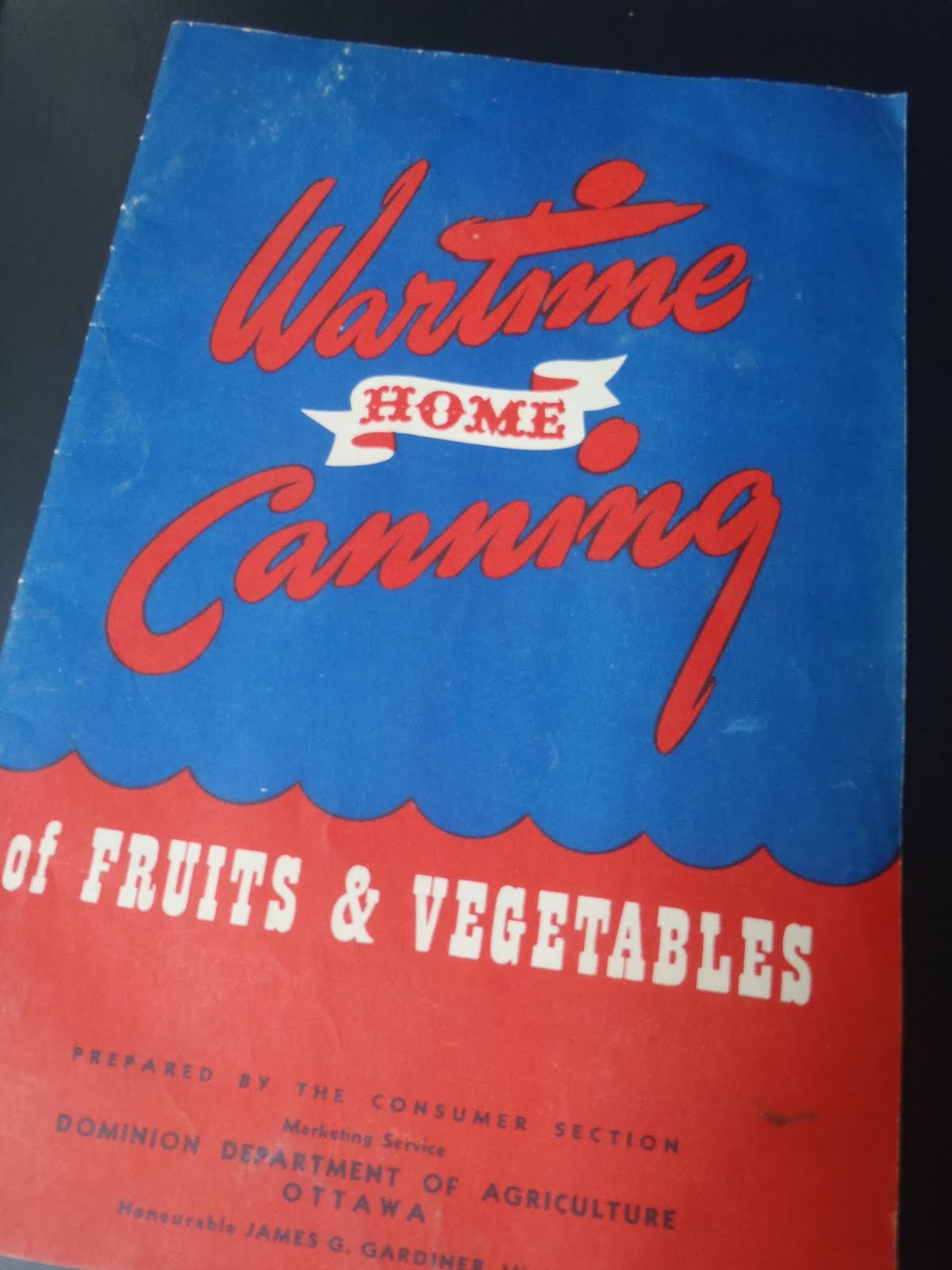
A government publication called 'Wartime Canning,' which I found in an antique shop in Nanton, ABGrowing up, I found that these two parts of my grandparents' lives, the farm and the war, intertwined in the government programs aimed at reducing stress on resources through rationing, Victory gardens, and teaching people how to preserve food. I doubt that my grandparents bought into the imagery and language of the home front propaganda ("Your apron is your uniform!") They had grown up on small farms during the depression, and were already well-seasoned in canning food and growing vegetables by the time the war came about. However, with brothers and friends fighting overseas, I suspect these activities took on a new significance.

WWII periodicals on rationing, canning, gardening, and other forms of self-sufficiency resonate with contemporary talk of sustainable food supplies. Take the following excerpt from a 1942 BBC radio broadcast by George Orwell. They say there's nothing new under the sun, and Orwell is clearly talking about "food miles," though he doesn't use that exact buzz-phrase.

If you have two hours to spare, and if you spend it in walking, swimming, skating, or playing football, according to the time of year, you have not used up any material or made any call on the nation's labour power. On the other hand, if you use those two hours in sitting in front of the fire and eating chocolates, you are using up coal which has to be dug out of the ground and carried to you by road, and sugar and cocoa beans which have to be transported half across the world.

In other words, sensible, modest living and eating were important.
Unfortunately, they require a kind of simple rationality that is almost extinct. Why, for instance, do we buy cranberries made of fruit harvested from Carolinian bogs, processed, canned, and shipped to our supermarkets, when cranberries grow along the North Saskatchewan?

The only kind of kitchen thriftiness that gets attention these days is eating obscure cuts of meat. My own ancestors weren't particularly adventurous in that regard. They had their own reservations, and I'm sure that my grandma would find it strange that I now eat lamb's quarters and buffalo. Their thriftiness was based more around things like saving pan oils, especially from bacon.

Fried porridge with berries and maple syrup: deliciousThe pinnacle of my grandparents' generations' genius for kitchen economy was their use of left-overs. Of particular note is Aunt Dorie's fried porridge. When there was porridge left over after breakfast, she poured it onto a tray and let it congeal. The next morning she cut the sheet of porridge into rectangles and fried them in reserved bacon fat. This is the kind of craftiness that I thought could only come from Italians peasants (think: polenta).

That wartime mentality would be a boon to Albertan kitchens. Despite what we see on restaurant menus and grocery store shelves, we live in a harsh province. Our food should be more humble and austere than that from, say, California.

We don't need to be survivalists. In fact, complete self-sufficiency is a myth that has run wild in North America, especially on the prairies, with our "frontiersmen" heritage. That being said, we rely far too much on others to grow and cook our food.

Our backyards are Victory Gardens. Our kitchens are War Rooms.


Before the war there was every incentive for the general public to be wasteful, at least so far as their means allowed. We have learned now, however, that money is valueless in itself, and only goods count. In learning it we have had to simplify our lives and fall back more and more on the resources of our own minds instead of on synthetic pleasures manufactured for us in Hollywood or by the makers of silk stockings, alcohol and chocolates. And under the pressure of that necessity we are rediscovering the simple pleasures - reading, walking, gardening, swimming, dancing, singing - which we had half forgotten in the wasteful years before the war.

- George Orwell, from a BBC broadcast entitled Money and Guns, aired in January 1942