Showing posts with label Pork. Show all posts

Sunday, October 30, 2011

Back Bacon

In the States this preparation is called Canadian bacon, but we usually call it back bacon.  It's more or less the same process as regular bacon, only done to a section of the loin instead of the belly.  There's an old style of back bacon from eastern Ontario called peameal bacon, in which a cured section of loin is rolled in peameal (crushed split-peas) before being smoked.  Peameal bacon is still made down east, though nowadays cornmeal is used.

Back bacon is usually made from the eye of loin: the large, round muscle often made into centre-cut pork chops.  You can also use the rib- and sirloin-ends of the loin, which have more fat and flavour than the centre.  I tried the classical eye of loin.

First the loin must be cleaned.  There is a band of meat and fat called the chain (in the top right corner of the picture below) that must be cut out, but can be reserved for ground meat.  There is also some fat and silverskin (top left) that can be removed and discarded.  I cut my cleaned loin into three sections so that it could fit in my curing bucket.


The main procedural difference between back bacon and belly bacon is that back bacon is usually brined instead of dry-cured.  My brine consisted of salt, curing salt, brown sugar, herbs, and a halved, squeezed lemon.  I used a ceramic plate to keep the meat submerged.


After sitting in the brine for a few days, the eye of loin is tied so that it will have a round cross-section.  In the picture below you can see three different colours on the meat: there are brown parts, pink parts, and a light grey part.  The cure, having lots of brown sugar, is responsible for the brown areas.  The pink sections are where the loin sections were either pressed against each other, or resting on the botton of the container.  The grey circle on the bottom is actually a piece of meat that was cooked by the acidity of the halved lemon.

When curing with dry rubs, you have to "overhaul" the meat: rub it down every couple of days to redistribute the cure.  I guess the same should have been done for this brine.  At the very least the loin sections should have been rotated so that the surfaces got even exposure to the brine.  This is mainly an aesthetic issue, as the meat seems to have cured properly.
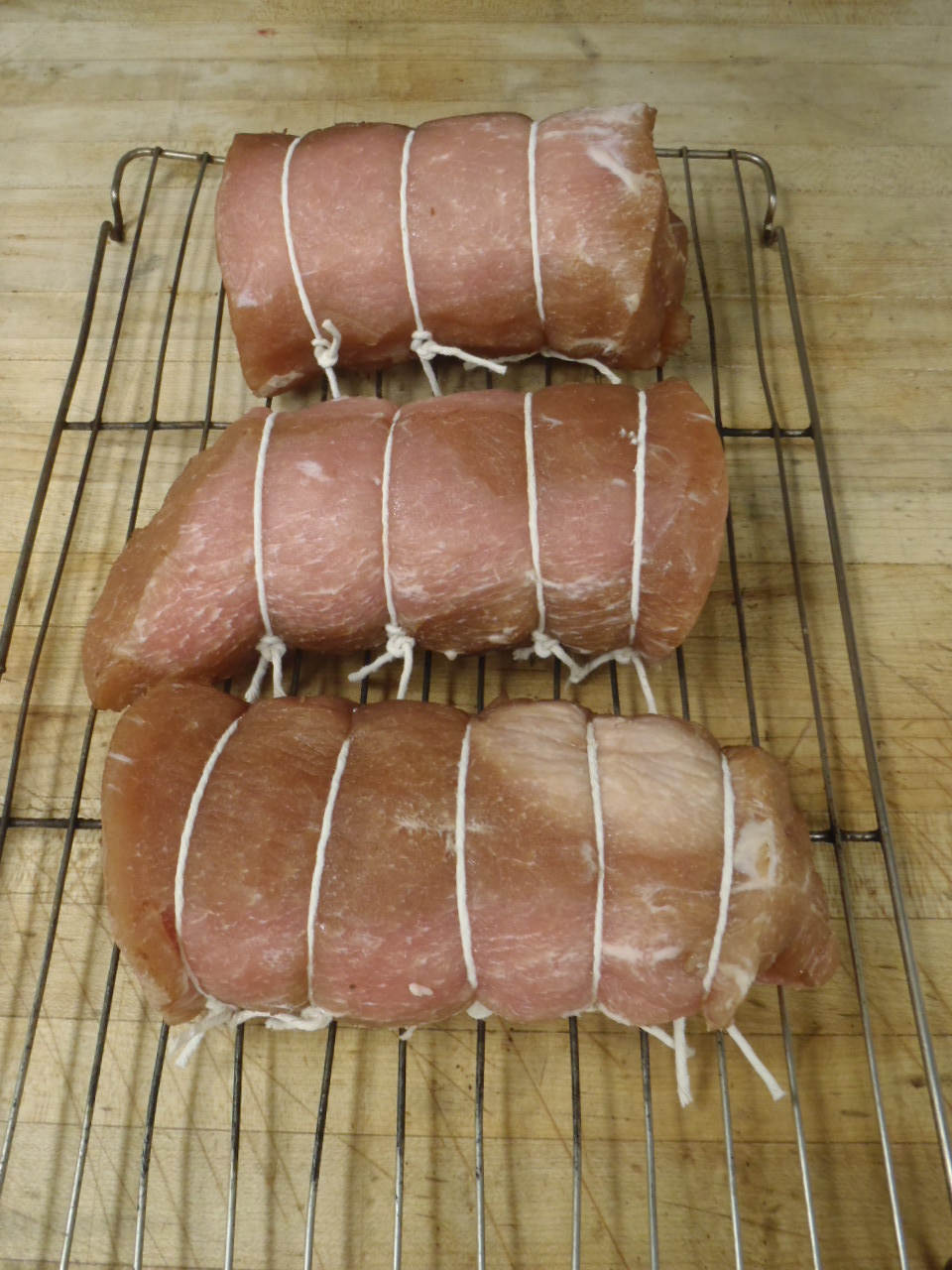


Next the loin is hot-smoked to an internal temperature of 65°C.  This is the most critical part of the procedure.  Since the eye of loin is an extremely lean cut, over-cooking will produce dry meat.


Here is the final product.  The curing salt in the brine has given the meat a rosy colour. 


The most important thing to remember when eating back bacon: it's not belly bacon.  It's not the fatty slab of crazy pleasure that you might be used to.  That being said, back bacon still has its place.  If it's brined and cooked properly it is by no means dry.  The smoke and herbs balance the piquancy of the curing salt.

Friday, October 28, 2011

Bath Chaps, Revisited

The first course of Button Soup's February Pork Dinner was cold-cut Bath chaps: a boned-out pig's head, cured, rolled around the tongue, tied, poached, and sliced.   While I was extremely happy with the look of those Bath chaps, they were pretty bland.  I figure that the cure leached into the poaching liquid.

I had another go at the chaps with this fall's pig.  This time, instead of using a whole head, I used only one jowl, cured, and wrapped around the tongue.

After rolling and tying, I seared the meat over high heat.  Once chilled, I vacuum-packed the chaps and simmered them for two or three hours.  This was not proper sous-vide: though the meat was vacuum-packed, it wasn't cooked in a low-heat, temperature-controlled bath.  A good hunk of fat rendered from the chaps, and some insanely flavourful jus leached out.  The plastic seal definitely helped the meat retain its cure.  The final plate was very flavourful, strong of garlic and herbs and brown sugar and salt.

I think that the vacuum-packing also helped bind the tongue and jowl together.

Obviously the presentation of these chaps isn't as striking as that of the whole-head chaps.  If I try tongue-and-cheek chaps again I'll trim the jowl to a uniform thickness.  You can see that the left side of the chaps, below, is thicker.  Trimming that down would give a more balanced presentation, and maybe even let the jowl wrap all the way around the tongue.

Wednesday, October 26, 2011

Scrunchions


These are scrunchions.  They're a bit like pork rinds.

"Pork rind" simply means pork skin.  It can refer to the fresh, raw skin cut from a side of pork, but more commonly it means pig skin that has been rendered and fried crisp.  It is actually the same as crackling, though commercially-produced pork rinds are much more delicate than the crackling that develops on oven-roasted pork.

Scrunchions are made by a similar process, but they're made of raw pork fat, not skin.  I can't figure out how frying pure back fat results in a crisp product, but it does.  Scrunchions are one of the finer components of Newfie cuisine, along with chow-chow, screech, and saltfish.

Like so many kitchen preparations, the snack pictured above was a happy accident.  I had not planned on making scrunchions that day.  Rather, I was cooking a large rib roast.  My haggard butchery had left a slender flap of back fat hanging off the roast in the dry heat of the oven.  Part way through the roasting I realized that this flap had crisped into a scrunchion, so I cut a number of slices of fat from the roast and left them on the wire rack beside the meat.

Once crisp the scrunchions were removed to a paper towel and sprinkled with sea salt and chopped thyme.


How to Make a Paper Cone for Scrunchions

This is also how pastry cooks make impromptu piping bags from parchment paper.

Cut a 8" x 8" square of parchment paper.  Cut the square into two right angled triangles.  Orient one of the triangles so that the hypotenuse is towards you, like so:


Roll the bottom left corner so that its tip meets the tip on the top centre:


Now roll the bottom right corner around the cone, so that its tip meets the other two.


You should be able to pinch all three corners:


Fold the three corners down.  Fold them once more to secure the cone.


The cone should now hold its own shape, without the use of tape.

Monday, October 24, 2011

October Kills its Pig

Everybody rejoices when November kills its pig.
-an inscription on the Münster Cathedral


Edmonton gets cold enough to butcher outdoors a bit sooner than Westphalia, so our version of the inscription would have October killing the hog.

This year Lisa and I bought a side of pork from Nature's Green Acres.  I cut up our meat at Kevin's, on what he and his family call Pig Day.  While the majority of the pork was wrapped and frozen, there was also some curing, smoking, and grinding, processes that have come to typify the season.


Brine-Curing

Processing a side of pork is made less daunting by the presence of a brine bucket.  Certain pieces can go straight from the cutting board to the brine, making for less wrapping, labelling, and freezer management.

There are two types of brines. The first contains only table salt and other flavours like brown sugar and herbs. Salt is absorbed into the meat so that it is seasoned throughout its mass, and not just on the outside. The meat will retain more moisture during cooking. I call this a "seasoning brine."  This is a relatively quick process: I might brine a thick pork chop for four hours before cooking it.

If sodium nitrite is added to the brine, some additional, complex chemical changes occur. The meat develops a vibrant pink colour and a piquant flavour. I call this a "curing brine," to contrast it with the seasoning brine explained above. The curing brine takes longer than the seasoning brine.

Seasoning brines are typically made the day that you cook the meat. Curing brines can be started the day that the pig is fabricated.  Cuts that are typically brine-cured include hocks, hams, eye of loin (Canadian bacon), and the tongue.


Dry-Curing

Other cuts are better cured in a dry rub.  This is especially true of fatty pieces like the jowl and the belly.  These cuts get mixed with the dry cure (salt, curing salt, sugar, herbs), then bagged and left in the fridge for a week, after which they are rinsed and either air-dried or hot-smoked.


Grinding Meat and Making Sausages

When I first started cutting my pig, I assumed that all the trim would supply ample meat and fat for grinding. This may be true of professional butcher shops that produce portion-controlled chops with clean bones, but when the pig is separated mostly into large roasts, there is actually very little trim.  A portion of the shoulder must be specially reserved for ground meat.  I shoot for a 3:1 ratio of meat to fat.

I store my ground meat in three forms. First there are one pound bags of ground pork, unseasoned, ready to be made into patties or pie filling.  I also find it handy to freeze some loose ground pork that has already been seasoned and spiced.  Finally there are sausages.


Making Stock

Even with many of the bones staying in roasts (the hocks, trotters, rib roast, hams...), there are still plenty left to make stock.  Sections of the backbone, as well as the riblets, skull, tailbone, shoulder blade, and arm bone are lightly smoked on the barbecue, thrown in a pot, covered with cold water, brought to a boil, then simmered for twenty four hours.  The next day I add the vegetables and simmer for an hour, then the herbs, which are simmered for fifteen minutes.

Finally the stock is strained and cooled, then frozen into ice cube trays so that it can be used a little at a time.


Rendering Fat to make Lard

We keep a lot of fat on the roasts and steaks, so we set aside a section of back fat especially for rendering.  There is also the leaf lard, the brittle fat around the kidneys, analogous to the suet in sheep and cows.  All the fat is thrown in a heavy stainless steel pot with bit of water and put over very, very low heat.  The water helps distribute the heat in the early stage of the rendering.  Eventually the water evaporates, but by that time enough fat has melted to serve the same function.  I typically leave my fat on the stove overnight.

Monday, May 16, 2011

Dandelion Salad

At left is the first harvest from the yard, largely rhubarb and dandelions.

When picked young dandelions are tender and bitter, with a slender red stalk. Classically, they are often served with bacon, garlic croutons, hard-boiled egg, and vinaigrette.

Here's a variation on that theme.

Firstly, in addition to the greens, this year I gave the roots and flowers a go.  The roots have the same bitterness as the leaves, obviously with an added crunch.  The flowers are very fun to eat.  They have a slight sweetness

Instead of the classic hard-boiled egg I used a soft-poached quail egg.  When broken, the yolk runs through the leaves and tempers their bitterness.

The dressing was made with cider vinegar, a touch of mustard, a touch of bacon fat, and canola oil

Instead of bacon I used pig's ear.

I should tell you a bit about pig's ear.

When I make headcheese, I simmer the entire head of the pig.  To make the soft, creamy version of headcheese that I enjoy, I include mostly the jowl fat and the tender meat.  I exclude parts of the head that will conflict texturally, notably the ears, which have cartilage in the them.

Since they have been simmered extensively, these bits of ear were coated in seasoned flour and fried crisp.

At first bite, the fried ears are not much different than crispy bacon. Once you reach the centre there is the distinct crunch of the cartilage.  A very interesting eating experience.

This salad goes well with weissbier.


Thursday, March 3, 2011

Stuffed Trotter

Pig's trotters were a bit of a mystery to me until recently. Before the Button Soup Pork Dinner, I had only ever used them in stocks and soups. With so many joints and cartilage, the feet release large amounts of gelatin when simmered, giving the final broth a rich mouthfeel. However, once the feet had delivered their gelatin payload, I always picked them out of the pot and threw them away.

Then I started coming across dishes in which the trotter itself is eaten, notably in the fantastic BBC mini-series Marco. The series, which I think is from the late 1980s, though I don't know exactly what year, is a glimpse into the kitchen at Harvey's, a London restaurant where the chef Marco Pierre White was setting the British cooking scene ablaze. Marco is precocious, demanding, and eloquent. The show is so beautiful it makes grown line-cooks weep (gaudy 1980's plating notwithstanding).

Anyways, in the episode entitled "Marco cooks for Raymond Blanc," Marco prepares a dish called trotters Pierre Koffmann: a boned pig's foot stuffed with chicken mousseline, veal sweetbreads, and morel mushrooms. I wondered: when you eat a trotter, what exactly are you eating? Is there meat to be had? I resolved to cook them myself and find out.
The trotter dish for the Button Soup Pork Dinner was based on Marco's, but with a simpler stuffing: potatoes and morels.


Preparing the Trotters

As with all the cuts used in this dinner, the trotters were torched to remove the remaining hairs. This is how one of the cleaned trotters looked:


Next came the removal of the long foot bone. There is footage of Marco boning a trotter in the above mentioned "Marco Cooks for Raymond Blanc". You can watch it here. It takes him about ten seconds.

An incision is made along the back of the trotter, and the skin is then cut away from the bone.


Be extremely careful not to nick the skin with the knife. When you cook the trotter, small cuts will open and become large holes. Continue to remove the skin until you reach the joints where the two outside claws connect to the foot. Cut through these joints, then snap the joints on the two central claws by bending them. It takes a bit of muscle. Sever the broken joint with your knife.

You are left with a sheet of skin attached to four little toes.


Cooking the Trotters


I cooked the boned trotters in a mixture that was one part light chicken stock and one part brown ale, with a handful of mirepoix thrown in for good measure. Simmer the trotters very gently for about three hours. It's important to cook the trotter thoroughly without overcooking. If you simmer too long, the sheet of skin will fall apart, and you won't be able to stuff it.

When the trotters were done I strained the cooking liquid and reduced it to make a sauce for the finished dish. A dark, malty, and slightly bitter sauce.


The Stuffing

Reconstitute the morels by soaking them in cold water. Save the soaking liquid; it's almost as valuable as the mushrooms themselves.

Peel some starchy potatoes, cut them into manageable cubes, and simmer until tender. Mill the potatoes while still hot.

Add oil to a hot pan. Sauté the morels. Add some finely diced onion, lower the heat, and cook until translucent. In a separate pot, bring a small amount of the morel soaking water to a boil. Add the milled potatoes. Stir while adding several cubes of butter. Fold in the morels and onions and season the mixture.

Fill the feet with the potatoes. Wrap the feet first in caul fat, then in foil or plastic. Leave the wrapped trotters in the fridge overnight. They'll set, and be much easier to work with the next day.


Interlude: Braised Cabbage with Cured Jowl

The accompaniment to the stuffed trotter was braised cabbage, the foundation of which (in my house, anyways) is always bacon fat and onions. As I mentioned in the first post about this dinner, I was working with two pig's heads. One became the bathchaps, while from the other I harvested the jowls, tongue, and ears. The jowls were cured and dried, and used in the braised cabbage. The tongue and ears were reserved for future projects.

A cured jowl:


We rendered as much fat as possible from the jowls, then sautéed the onions and cabbage in that liquid gold.


Cider vinegar and stock were added, and the pot was covered until the cabbage was tender.


Serving

Brown the trotters over high heat. If you've ever made crackling, you know that skin tends to pop when cooked at high temperatures. These feet, covered in skin as they were, spit oil everywhere. It was terrifying.


Once thoroughly browned, keep the trotters in the oven until heated through.

The trotters were cut into sections, rested on the cabbage, and covered with a bit of the beer reduction.


This was far and away the most surprising dish of the night. It was utterly unlike anything I have eaten before. Turns out there isn't any meat in the trotter; it's pretty much just skin, with a bit of fat and connective tissue underneath. The finished dish had an overwhelming gelatinous, sticky mouthfeel. It was one of the riches dishes I've ever eaten. The cabbage accompaniment, with the cider vinegar, was designed to cut some of that richness, but the real hero in that regard was a jug of Kevin's apple wine, which cut through the trotter like a lance.

I really enjoyed the dish. However, with all the starch, fat, and acid, the morels never stood a chance. I would omit them in future attempts.

Wednesday, March 2, 2011

Crisp Pig's Tail with Broth

A pig's tail is an extension of its spine: a sequence of small vertebrae, surrounded by meat, and fat, and skin. The tail meat itself is not so different than the meat from, say, the shoulder. You are, however, afforded the pleasure of gnawing the meat off the bones.

The tail is a surprisingly tough muscle that needs to be simmered for a few hours to become tender. This got me thinking about the broth that would result from the cooking process. It happens that my second favourite soup of all time is ham soup. When smoked ham hock is simmered with vegetables, the resulting liquid somehow takes on the flavour of the meat without any noticeable detraction from the flavour of the hock itself. The final soup is comforting, smoky, salty, savoury, perfect for cold weather, and a great example of the ingenuity inherent in so many simple, frugal dishes. I decided I would serve the tail-broth alongside the crisp tail.


The Process


As with heads, tails usually have some whiskers that need to be shaved or singed. You can see that my tails both had a small piece of the rump still attached. That meat was later used as a garnish for the broth.


With the ham hock soup in mind, I kept the tails in a standard brine (salt, brown sugar, curing salt, herbs) for about a week.


After brining, the tails were patted dry and left overnight in the fridge, uncovered, to dry out the surface. The next day they were hot-smoked, then simmered with vegetables, herbs, and, to add a little body to the finished stock, a couple of trotter bones.

Once the meat was tender, about three hours, the broth was strained and chilled so that the fat could be removed.

I pulled the chunks of rump meat from the tails, then cut the curly-queues into segments. Each tail was about nine inches long, so with six diners, everyone got a three inch piece.


We coated the tails with seasoned flour, egg wash, and bread crumbs.


Finally we fried the tails until brown and crisp. They were served with hot mustard. Brined, smoked pork, clinging to a bone: a bit like a ham lollipop.


The broth was reheated and simmered with a few sprigs of rosemary. Once thoroughly infused, it was poured over green lentils, vegetables, and some of the shredded rump.

The flavours were simple and direct: smoke, rosemary, and pork. A restorative broth to be sure.


Monday, February 28, 2011

Cured Bath Chaps

Bath chaps with peppergrass, apples, and pumpkin seedsBath chaps are the flesh from a pig's head, removed from the skull and wrapped around the tongue. The "bath" part refers to the town of Bath, England, where the preparation became famous. I assume the "chaps" part refers to the two meaty jowls straddling the thinner snout, though that's just a guess. Bath chaps are usually brined then simmered, and either eaten hot or cooled and used as a cold-cut.

There is a very similar preparation from old Italian peasant cookery called porchetta di testa. As I say often on this blog, I favour the strong Anglo-Saxon descriptions, even if they aren't as precise or pretty as the French, Italian, Latin, et c.


The Process

1. Clean the head. This was the first time I've worked with a whole pig's head. Usually the entire animal is cut in half down the spine and through the head. Bath chaps require an intact head. If you ask your pork vendor really, really nicely, they should be able to get one for you.

The head must be cleaned thoroughly. Considering how much hair is on a live pig, the abattoirs do a pretty good job of cleaning them up, but there will always be some persistent whiskers that need to be shaved or singed off with a blowtorch. Beware that burning hair has a very strong, peculiar smell, so it's best to work outside or at the very least under a proper vent hood. After singeing, scrape the black residue away with a knife and wipe the skin clean. There will be a few nooks that need to be cleaned, notably the folds of the ears. Q-tips don't stand a chance: you have to use a slender knife. You may find it easier to clean the inner parts of the ear after the head has been boned out. Actually I sometimes cut the ear canals out instead of cleaning them.

A pig's head, cleaned and awaiting my boning knife
2. Bone out the head.
You can remove all of the flesh from the skull in one piece. Make an incision under the chin, then start cutting the jowls away from the jaw, staying as close to the bone as possible. Work up the jaws, past the temples and eyes to the earls and forehead, and finish with the snout. There is a good video of Chris Cosentino boning out a head here. He also describes the basic process for making porchetta di testa.

Once the meat has been removed from the skull, the tongue can be harvested. My first inclination was to open the pig's mouth and cut out the tongue, but by the magic of rigor mortis, the jaw muscle was thoroughly seized. The best course of action is to cut and pull the tongue out through the bottom jaw. A detailed description of the process can be read here (the description is for game animals, but the details are transferable to swine...)

You should now have one sheet of flesh and one tongue.

The flesh and skin removed in one piece from a pig's head
3. Cure the meat.
I cured the head and tongue as I do bacon, pancetta, and jowls ("guanciale"). My "house cure" contains fir (part of my ongoing attempt to eat my Christmas tree), juniper, brown sugar, black pepper, kosher salt, curing salt, bay, garlic, nutmeg, and herbs. Cover the meat with the cure and leave for a week in the fridge, or until the flesh is firm throughout.


The boned-out head rubbed with cure
4. Roll and tie the meat.
In the video mentioned above, Cosentino tucks the tongue into the snout, then rolls the entire sheet of flesh in one direction. His finished cross-section is one spiral.

I tried a different rolling method, one that was intended to preserve the natural shape of the head, with the bulbous "brain portion" tapering to the snout. I rolled the two jowls towards the centre. The rolled head looked absolutely ridiculous (see below), especially with the awkward seam where the two rolled jowls met. In the end, however, I think it resulted in a more interesting cross-section. I'll talk more about that later.

The wrapped pig's head, from the top
The wrapped pig's head, from the bottow
5. Cook the bath chaps.
Ideally this is done by sealing the chaps in plastic and cooking sous-vide. There are several advantages to the vacuum packing:

  • the gelatin released by the meat is kept in the chaps, binding the different elements and resulting in a more cohesive product,
  • none of the flavours from the cure are leached into the cooking liquid, and
  • the meat cooks more evenly.
Unfortunately I didn't have access to a vacuum packer, so I just covered the bath chaps in cheesecloth and simmered them. I threw some mirepoix into the poaching liquid.

Poaching the wrapped pig's head

6. Slice. Frankly I was discouraged by how ridiculous the bath chaps looked in their whole, uncooked form, but when I sliced them after cooking, I was overjoyed. The cross-section was striking and distinctive: the shades of red and pink and white, the symmetrical curls of the jowls, the bright band of ear cartilage clinging to the perimeter.

The cross-section: red, white, and delicious
7. Consume. You might expect something like this to taste as odd as it looks. This was not the case, not by a long shot. Honestly it tasted like bologna. Most of the interest came from textural interplay: the firm meat, the slightly chewy skin, and the crunch of the ear.

The final plate: sliced bath chaps with peppergrass, apples, and pumpkin seeds, all dressed with a cider and pumpkin oil vinaigrette
The meat was sliced very thinly, arranged on a broad, round plate, sprinkled with salt, black pepper, and pumpkin seed oil, and garnished with the following salad.

  • shaved ambrosia apples
  • peppergrass (a fiery shoot that tastes like nasturtium)
  • toasted pumpkin seeds
  • a vinaigrette made of 2 parts pumpkin seed oil and 1 part apple cider vinegar, with a bit of hot English mustard
  • salt and pepper
This is a preparation that I'm sure I will try again at some point. Next time I would like to vacuum-pack the bath chaps before simmering, as I think a lot of the flavour from my cure was lost to the cooking liquid.

Looking at the picture of the whole pig's head, then at the picture of the finished plate, I'm amazed by the transformation. Very gratifying.

Button Soup Pork Dinner

a-pol-o-gy
noun,
plural
-gies

1. a written or spoken expression of one's regret, remorse, or sorrow for having insulted, failed, injured, or wronged another
2. a defense or justification in speech or writing, as for a cause or doctrine


Button Soup Pork Dinner

The Button Soup Supper Club's February dinner was based around the least desirable cuts from two hogs, namely:
  • two heads,
  • two tails, and
  • four hind trotters.
These cuts contain pounds (pounds!) of good meat and fat that usually end up in the garbage. With a little effort, they made a dinner for six guests, with lots of leftovers.


A Quick Apology, in the second sense of the word.

The cooking that I am taught in school, and the cooking that I practice in restaurants, is a bit, to speak delicately, narrow. It focuses on a few "choice" cuts of meat, like rack of lamb, breast of poultry, and loin of pork and beef: relatively lean, tender cuts that can be cooked to order over dry heat.

I sometimes joke about how strange Albertan cows must look, as they only yield tenderloins, striploins, and cheeks (as opposed to, say, Vietnamese cows, which give us flank, brisket, tripe, tendon, and a myriad of other delicacies.)

I don't mean to suggest that cooking a filet mignon is a cop out: obviously there are subtleties to the preparation, and pleasure in the consumption
of those choice cuts. But cooking the less desirable "variety cuts" is a different experience entirely. You may have to research and experiment with cooking methods, and you'll most likely spend a great deal more time in the preparation. The meat, however, goes through a remarkable transformation, one much more profound and striking then when you sear a tenderloin. In the end you are sometimes rewarded with a new set of tastes and textures.

Some of the following posts are a little weird, but I want to stress that my goal in writing them isn't to shock or disturb. The posts are rooted in curiosity, as well as a reverence for farmers, pigs, and the culinary heritage that informed the meal.


An interesting thing about the heads, tails, and trotters: though they are rarely used, strictly speaking they aren't offal. Offal is any part of the animal that isn't included in the dressed carcass. When you buy a side of pork, the viscera such as the liver, heart, and kidneys have been removed. Those organs and muscles are the offal. The head, tail, and trotters, however, remain on a dressed side of pork. These cuts are therefore extremely easy to get from vendors at the farmers' market, and insanely cheap to boot (trotters are a buck a piece). Anyways, here is the menu from the dinner. Posts on each course will follow shortly.


Bill of Fare


To Begin
: cured bath chaps with apples, peppergrass, and pumpkin seeds

Soup
: lentils in broth with crisp smoked tail

Main : trotters stuffed with potato and morels, braised cabbage, and apple wine

To End : sugar pie, brown beer with raspberry liqueur, and the last of the season’s rumpot

Thursday, December 23, 2010

Fir-Smoked Ham

If you consult a North American resource on smoking meat, you're likely find something like the following:

The first rule of smoking meat: use hardwood. Apple, hickory, maple, oak, pear, cherry, whatever you please, but do not use soft wood, and especially not evergreens. They are extremely resinous, and not only do they produce harsh, turpentine flavours in the meat, they are also poisonous!


These comments are discouraging to someone who lives where the prairies meet the boreal forest. Of course there are hardwood trees in Edmonton, but they're not nearly as common as, say, poplars and spruce. There's a spruce tree in my front yard that, if left to its own devices, will someday eat my house. There's a fir tree in my living room right now, and in the new year I'll put it on the curb and the city will take it away. Too bad I can't use any of that resinous wood, or any of those perfumed needles, to flavour my cured meat...

A lone sentence in Larousse recently changed how I look at my Christmas tree: "Westphalian ham is... cold-smoked over strongly resinous wood." After a little more research I found that there are several German hams that are smoked with wood from evergreens. Black forest ham, for instance, is smoked over fir. (That is, real black forest ham is smoked over fir: while black forest ham is a protected designation in Europe, in Canada and the States the name can be applied to the many inferior knock-offs.)

I decided to try smoking some brined ham hocks with balsam fir needles and twigs. Usually I am an all-or-nothing sort of cook, but at the last minute I decided to temper my fir trim with conventional hardwood chips.

Once the smoke got going I could smell the pronounced sweetness of the hardwood, spiked with some harshness from the softwood, specifically, the smell of burning tar, reminiscent of cigarettes.

I was really hoping to get a striking layer of black soot from the fir, but the final colour of the hocks was the same mahogany that you get from conventional hardwood smoking.

Hardwood smoke can be sickly sweet and strong of vanilla, but the pine and tar flavours of the fir added some complexity to the finished hams. The smoking process still needs a lot of work. There are lots of questions to be answered:
  • Which part of the tree should be used: the needles, the wood, or both?
  • Should the needles or wood be fresh? Dried? A combination of dried and soaked?
  • Hot smoke or cold? Perhaps cold-smoking mutes some of the harsher characteristics of evergreen smoke?
At this point all I can say is that there is some potential for a good regional specialty.

Wednesday, December 22, 2010

The Boar's Head

The boar's head in hand bear I,
Bedeck'd with bays and rosemary.
And I pray you my masters, be merry
Quot estis in convivio
(As many as are in the feast)

-English Traditional


Has it ever taken you years to understand the lyrics to a certain song?


I grew up listening to a carol that I thought was in a different language. While a few lines are in Latin, the rest is in plain English. Even so, I only deciphered the meaning of the song last year. The carol is The Boar's Head, and it refers to the English custom, dating back to Anglo-Saxon times, of serving a boar's head at Christmastime. The head was placed on a silver platter and marched into the hall with music. When I first read about the custom last year, I resolved that this Christmas I would roast a boar's head, bedeck'd with bays and rosemary.


I rested the head on a bed of onions, celery, apples, bays, rosemary, and thyme, and cooked it in a very low oven for several hours. The jowls release a lot (a lot!) of fat, which is good for frying bread as an accompaniment. The head finishes with very tender flesh and very hard crackling, and the whole mess is liberally salted and peppered. Good food for the longest night of the year, which we usually observe with
heavy drinking.

Caput apri defero (The boar's head I offer)
Reddens laudes Domino (Giving praises to the Lord)
Caput apri defero
Reddens laudes Domino

The boar's head I understand
Is the rarest dish in all the land,
And thus bedeck'd with a gay garland
Let us servire cantico (serve with a song).

Our steward hath provided this
In honour of the King of Bliss;
Which on this day to be served is
In Reginensi atrio
(the Queen's hall)


The boar's head on its roasting pan, with onions, celery, apples, and herbs
The apple in the pig's mouth
A phenomenon that occasionally accompanies heavy drinking:

A snow angel in the front yard