Saturday, March 12, 2011

Lent

I've written a series of posts about the food that I cooked over the past couple months, a period I broadly refer to as the Easter season, though it also includes Lent and St. Patrick's Day.  We'll start with Lent.

Lent: A Primer, for the Uninitiated

What is Lent?

Lent is the Christian season of repentance and self-denial preceding Easter. It is commonly said to represent the forty days and nights that Jesus spent fasting in the desert. Until the 1960s, the Catholic Church had strict laws about what food could be eaten during Lent: all animal products, whether meat, eggs, butter, or cream, were forbidden.

Historically, this "meatless fast" was observed not only during Lent, but on every Friday of the year. These fasts played an important role in European history. They were a major point of contention between Rome (where olive oil was common) and northern Europe (where animal fats like butter were common). During Lent, countries like Germany would have to buy huge amounts of olive oil from Italy. (It's not a coincidence that Germany and many other animal-fat-loving nations are now protestant.)

In medieval Europe there were ways around these fasts. The wealthy could buy dispensations from their local church, allowing them to eat animal products on fast days without divine consequence. The Church made a huge amount of money selling dispensations. The tallest tower of the Rouen Cathedral in Normandy (which was the tallest building in the world for a few years in the 19th century) is often called The Butter Tower, because its construction was paid for largely by the sale of such dispensations.[1]

Fish is not considered meat in Catholic dietary law, and many a medieval European lived half  his life on some form of gruel and salt cod.


Catholics continued to observe these laws until a papal decree in 1966 made Lenten fasting more or less optional. These days Catholics will voluntarily give something up for Lent, whether it be meat, alcohol, Jersey Shore, et c.  When I was little we usually gave up candy, which made the chocolate eggs and bunnies of Easter morning all the sweeter.


When is Lent?

Let's work backwards. Easter is on the first Sunday after the first full moon after the spring equinox. This year the equinox (ie. first day of spring) was on March 20. The first full moon after that was Monday, April 18, so Easter was the following Sunday, April 24.

Look at a calendar. Starting at Easter Sunday, go back exactly one week: that is Palm Sunday, the start of Holy Week. Go forty days back from Palm Sunday and you should be on Ash Wednesday, the first day of Lent.

Lent corresponds to one of two seasons traditionally associated with famine: early spring, when winter stores are running low and spring crops haven't yet appeared.[2] Easter, at the end of Lent, occurs during the greatest time of rebirth in plants and animals. (Maybe not so much in Edmonton, but definitely in places like Rome and Avignon...)  The "spiritual seasons" of the Catholic Church mirror the natural seasons.

I have a special interest in this seasonality, because in our industrial food system there are no seasons, let alone seasons of scarcity. I have never in my entire life, for instance, been more than a few hours from my next meal.  The only seasonality in the supermarket is in prices: you can buy strawberries in January, but it will cost $20 a pint.


Following are some posts about the food I cooked and ate during Lent.


References

1. Soyer, Alexis. The Pantropheon: or, a History of Food and its Preparation in Ancient Times. ©1977 Paddington Press.  Page 172.  There's a copy of this book at Cameron Library on the U of A campus.
2.  Civitello, Linda.  Cuisine and Culture, Second Edition©2008 John Wiley and Sons, Inc.  Pages 59-60.  The other famine-time is mid-summer, when the crops have been sown but aren't ready to harvest.

Sunday, March 6, 2011

On Curing Salts (and Fearmongering)

Have you seen this commercial for McCain's frozen pizza?

"What do other companies put in their pizzas? Something called sodium nitrite..." Those last two words are pronounced with a blend of confusion and self-righteous disgust. The molecular diagram of the compound is flashed across the screen for further effect.

The food industry is quick to pick up on trends.

My generation was taught to read labels, and to mistrust "chemical" ingredients. However:

The resistance to... 'scientific' ingredients has always seemed to me misguided. In the objector's mind a line is drawn between science and cookery, which usually turns out to be entirely arbitrary. No one objects to table salt (sodium chloride) or table sugar (sucrose) in a recipe, but an ingredients list that includes fructose or sodium citrate is viewed by some with suspicion.[1]


The Complete Skinny on Curing Salts


How salt preserves food

Imagine microbes within a piece of meat. When salt is first added to the meat, there is a relatively high concentration of salt outside the microbes, and a relatively low concentration inside. The cells of the microbes try to equalize the salt concentration on both sides of the cell membrane by expelling water and taking in salt. This ultimately either kills the cells or severely reduces their functionality. The meat itself also loses water and takes in salt, thus making it inhospitable to any microbes that show up later. That is how salt preserves food.

The difference between table salt and curing salt

Cured meats were once made with table salt, sodium chloride. This is the salt on your kitchen counter, and the salt you taste when you swim in the ocean. However, for hundreds of years we have known of other salts, naturally occurring in small quantities, that are even better at improving the flavour and storage-life of cured meats.

One such salt is potassium nitrate, or saltpeter, which is still used in Europe. In North America, potassium nitrate has been replaced by sodium nitrate, which was found to be more reliable.


The reasons why these nitrates are better than table salt at preserving meat are several and complex. Here's an example. Iron oxidizes fat, turning it rancid. When added to meat, nitrates form nitric oxide, which binds to iron atoms, preventing them from oxidizing the fat, and prolonging the storage-life of the meat.[2]

The difference between sodium nitrate and sodium nitrite


While nitrates have been added to cured meats since at least the 17th century, in the 19th century it was discovered that salt-resistant bacteria in the meat convert the nitrates to nitrites, and that nitrites are actually the active curing agents.

Now sodium nitrite can be added directly to curing mixes. Meats that will be cured for only a short while (say, a few hours in a smokehouse), are treated with sodium nitrite. Meats that will be hung in a cellar for several weeks are treated with a blend of sodium nitrite and sodium nitrate, which is slowly converted to nitrite, thus protecting the meat for the entire curing process.

Retail forms and terminology

Here's where it gets really confusing.

You can't buy 100% sodium nitrite (unless you work at a pharmacy, maybe). It will always be cut with regular salt. In the US the most common form is a mixture of 93.75% sodium chloride, and 6.25% sodium nitrite. Brand names include Insta Cure #1 and Prague Powder. When buying from butcher suppliers in Edmonton, the most common mixtures are actually 95% sodium chloride, and 5% sodium nitrite, possibly with trace amounts of sodium bicarbonate (baking soda), which is an anti-caking agent. The mixture will likely be called F.S. Cure, which is made by a company called First Spice, then packaged for the supplier that you are buying from.

In the US, curing salts are tinted pink so that they aren't confused with table salt. This gave rise to the terms "pink salt" and "tinted cure mix" (TCM) for sodium nitrite. For some reason, this precaution is not taken in Canada. The curing salts I buy are white as snow, though they are still sometimes called pink salt. It's commonly believed that the pink colour of cured meats is from the pink die in some curing salts. This isn't true: it has to do with the chemical reactions taking place in the meat.

In the US sodium nitrate is sold in a mixture of 92.75% sodium chloride, 6.25% sodium nitrite, and 1% sodium nitrate. It, too, is usually died pink in the US, but left white in Canada. The most common brand name is Insta Cure #2. From butcher suppliers around Edmonton you are more likely to be sold the F.S. Salami Cure, which can be used for all kinds of dry-curing, not just salami.

Health concerns

Curing salts have been demonized as a carcinogens. Here is a quote on the subject from the preeminent food scientist, Harold McGee.

...at present there's no clear evidence that the nitrites in cured meats increase the risk of developing cancer. Still, it's probably prudent to eat cured meats in moderation and cook them gently.[3]


Conclusion

Curing salts are in fact what make traditionally cured meats safe to eat. The simple truth is that dried sausages like salami that will be hung in a cellar for several days or weeks must be treated with nitrite and nitrate.

To completely avoid curing salts is to avoid the unique flavours and textures of traditionally cured meats like salami and bresaola. As for the "nitrite-free pepperoni" on McCain pizzas: traditional pepperoni is dried, and therefore requires the addition of curing salts. If McCain pizzas have nitrite-free pepperoni, this means one of two things: either they are improperly curing their meat, or they are not drying their pepperoni. Obviously the latter is what is happening. I would argue that the sausage on their pizza cannot properly be called pepperoni, as it isn't dried. Too bad pepperoni isn't a protected designation.


References

1. This is Heston Blumenthal in the history section of The Fat Duck Cookbook. I wrote the quote on a scrap piece of paper, without the page number, and have since returned the book to the library. Bad journalism.
2. McGee, Harold. On Food and Cooking. ©2004 Scribner, New York. Page 174.
3. Ibid. Page 125.

Saturday, March 5, 2011

Sugar Pie, and Tapping Maples in Edmonton(?)

The final course of the Button Soup Pork Dinner was sugar pie. If you are unfamiliar with this dish, let me introduce you by way of an aimless personal anecdote. If you are familiar with the dish, you can skip the next paragraph.

My father's family lives near Ottawa, my mother's near Sudbury. When I was little my family would sometimes drive between these two sets of relatives, following the Ottawa River valley, where there are lots of French communities, even on the Ontarian side of the border. Along the way we would always stop at a diner called Valois in the French town of Mattawa. For dessert they offered "sugar pie," a tidy translation of tarte au sucre. While some versions of sugar pie are made with corn syrup or molasses (
imagine a pecan pie without the pecans), I think the word "sugar" actually implies maple syrup, just as easterners might call a grove of maple trees a sugar bush, and the building where syrup is made a cabane à sucre, or sugar shack. Basically the dish is maple syrup thickened with flour and eggs, set in a pie shell.

This particular incarnation was a light, slightly sticky maple pudding in a short crust. In fact, the custard was so loose that if a slice was left to stand, the filling slowly ran onto the plate.


Sugar Pie

For the shell, bake off your favourite rich, short dough in a 10" French tart pan. I use the recipe from the CIA's Baking and Pastry text.
Be sure to dock and weight the dough while baking. Cool the shell thoroughly.

Ingredients
From The Canadian Living Cookbook

  • 500 mL maple syrup
  • 100 mL all-purpose flour
  • 250 mL cold water
  • 4 egg yolks, lightly beaten
  • 50 mL butter
Whisk the flour into the water, then stir this mixture into the maple syrup. Whisk in the egg yolks. Cook over low heat until thick. Stir in the butter. Pour into expectant pie shell. Chill thoroughly. Eat with whipped cream.


Tapping Maples in Edmonton: A Fool's Errand?


Even though maple syrup is popularly described as a "Canadian" ingredient, I consider it a highly regional specialty within Canada, as it's only made on a large scale in Eastern Ontario and Quebec. In contrast to the sugar maples that grow down east, the maple trees around Edmonton produce less, and less sweet, sap. Birch and elm can also be tapped for sap, but they have even lower yields.

These facts notwithstanding, I have a perverse obsession with maple syrup (one of my favourite desserts of all time is pouding
chômeur) as well as an abstract, academic nostalgia for the ingredient. Granulated sugar is one of the few highly refined products that I use regularly, and I'm interested in finding ways to replace it with, say, honey and maple syrup. Consider this:

For the colonists, maple sugar was cheaper and more available than the heavily taxed cane sugar from the West Indies. Even after the Revolution, many Americans found a moral reason for preferring maple sugar to cane; cane sugar was produced largely with slave labor. Toward the end of the nineteenth century, cane and beet sugar became so cheap that the demand for maple sugar declined steeply.[1]

Besides all this, making
maple syrup has an extremely low effort-to-benefit ratio: by drilling a hole in a tree and boiling the sap that leaks out, you can enjoy one of the great pleasures of the table.

Lisa and I are in the process of moving to a new house. Right now the backyard of that new house is a bit like a wrapped birthday present. The wrapping is the three feet snow that currently conceal the features of the yard. There are small tears in the wrapping, if you will: the tops of wooden stakes, promising some manner of garden; shrunken, frozen apples on one of the trees; and best of all, clinging to the topmost branches of a tall tree, those winged seed pods that fall to the ground spinning like propellers. Maple keys.

I resolved to tap this maple tree, though it is most likely of the low-sugar variety. I have only the most basic idea of how to do this.

  • Tap the tree when the sap is running. The sap runs during the spring thaw, when the days are warm and nights are cold. I thought that these conditions started last week, as there were two very warm days of rapid thaw. Then it started snowing again...
  • To tap the tree, drill a hole that is slightly smaller than the diameter of your spile (the metal spigot). The hole should go 2-3" into the trunk, at a 10-20 degree incline, anywhere 2-6' from the ground. Apparently south-facing holes have a higher yield in the earlier weeks of the sap run.
  • Lightly tap the spile into the hole and hang a bucket to collect the sap.
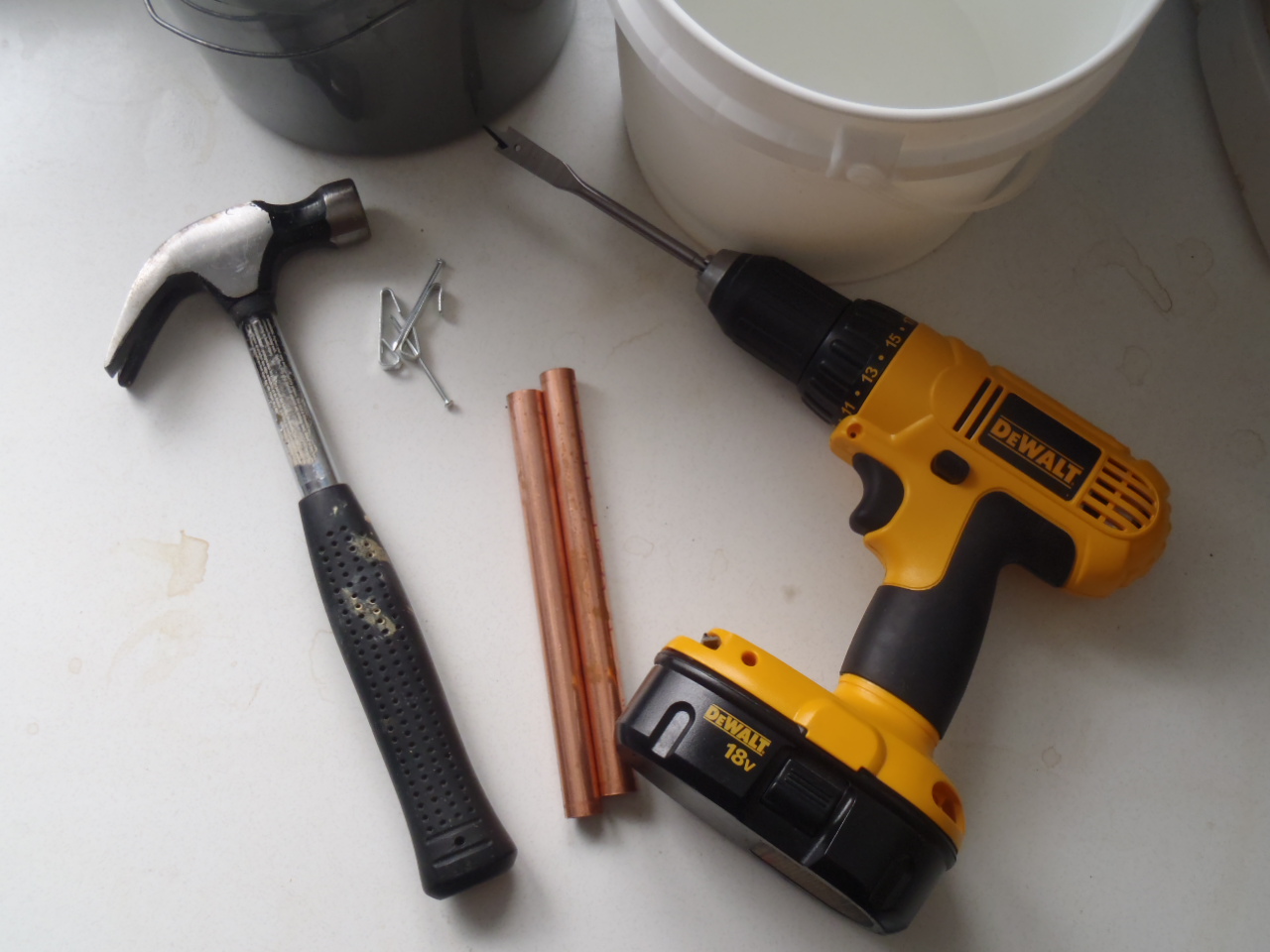
If I end up with even an ounce of syrup by the end of this, I'll be sure to buy proper spiles and buckets. In the meantime I'm using some 1/2" copper pipe from the plumbing section of the hardware store, and a plastic bucket supported by a wall hook. I covered the bucket with a plastic bag so that nothing falls into the sap.

Now we wait. Hopefully my premature tapping doesn't affect the process. I need a better almanac.

I'll keep you posted.


Reference


1. McGee, Harold. On Food and Cooking. ©2004 Scribner, New York. Page 668. I love this book.

Thursday, March 3, 2011

Stuffed Trotter

Pig's trotters were a bit of a mystery to me until recently. Before the Button Soup Pork Dinner, I had only ever used them in stocks and soups. With so many joints and cartilage, the feet release large amounts of gelatin when simmered, giving the final broth a rich mouthfeel. However, once the feet had delivered their gelatin payload, I always picked them out of the pot and threw them away.

Then I started coming across dishes in which the trotter itself is eaten, notably in the fantastic BBC mini-series Marco. The series, which I think is from the late 1980s, though I don't know exactly what year, is a glimpse into the kitchen at Harvey's, a London restaurant where the chef Marco Pierre White was setting the British cooking scene ablaze. Marco is precocious, demanding, and eloquent. The show is so beautiful it makes grown line-cooks weep (gaudy 1980's plating notwithstanding).

Anyways, in the episode entitled "Marco cooks for Raymond Blanc," Marco prepares a dish called trotters Pierre Koffmann: a boned pig's foot stuffed with chicken mousseline, veal sweetbreads, and morel mushrooms. I wondered: when you eat a trotter, what exactly are you eating? Is there meat to be had? I resolved to cook them myself and find out.
The trotter dish for the Button Soup Pork Dinner was based on Marco's, but with a simpler stuffing: potatoes and morels.


Preparing the Trotters

As with all the cuts used in this dinner, the trotters were torched to remove the remaining hairs. This is how one of the cleaned trotters looked:


Next came the removal of the long foot bone. There is footage of Marco boning a trotter in the above mentioned "Marco Cooks for Raymond Blanc". You can watch it here. It takes him about ten seconds.

An incision is made along the back of the trotter, and the skin is then cut away from the bone.


Be extremely careful not to nick the skin with the knife. When you cook the trotter, small cuts will open and become large holes. Continue to remove the skin until you reach the joints where the two outside claws connect to the foot. Cut through these joints, then snap the joints on the two central claws by bending them. It takes a bit of muscle. Sever the broken joint with your knife.

You are left with a sheet of skin attached to four little toes.


Cooking the Trotters


I cooked the boned trotters in a mixture that was one part light chicken stock and one part brown ale, with a handful of mirepoix thrown in for good measure. Simmer the trotters very gently for about three hours. It's important to cook the trotter thoroughly without overcooking. If you simmer too long, the sheet of skin will fall apart, and you won't be able to stuff it.

When the trotters were done I strained the cooking liquid and reduced it to make a sauce for the finished dish. A dark, malty, and slightly bitter sauce.


The Stuffing

Reconstitute the morels by soaking them in cold water. Save the soaking liquid; it's almost as valuable as the mushrooms themselves.

Peel some starchy potatoes, cut them into manageable cubes, and simmer until tender. Mill the potatoes while still hot.

Add oil to a hot pan. Sauté the morels. Add some finely diced onion, lower the heat, and cook until translucent. In a separate pot, bring a small amount of the morel soaking water to a boil. Add the milled potatoes. Stir while adding several cubes of butter. Fold in the morels and onions and season the mixture.

Fill the feet with the potatoes. Wrap the feet first in caul fat, then in foil or plastic. Leave the wrapped trotters in the fridge overnight. They'll set, and be much easier to work with the next day.


Interlude: Braised Cabbage with Cured Jowl

The accompaniment to the stuffed trotter was braised cabbage, the foundation of which (in my house, anyways) is always bacon fat and onions. As I mentioned in the first post about this dinner, I was working with two pig's heads. One became the bathchaps, while from the other I harvested the jowls, tongue, and ears. The jowls were cured and dried, and used in the braised cabbage. The tongue and ears were reserved for future projects.

A cured jowl:


We rendered as much fat as possible from the jowls, then sautéed the onions and cabbage in that liquid gold.


Cider vinegar and stock were added, and the pot was covered until the cabbage was tender.


Serving

Brown the trotters over high heat. If you've ever made crackling, you know that skin tends to pop when cooked at high temperatures. These feet, covered in skin as they were, spit oil everywhere. It was terrifying.


Once thoroughly browned, keep the trotters in the oven until heated through.

The trotters were cut into sections, rested on the cabbage, and covered with a bit of the beer reduction.


This was far and away the most surprising dish of the night. It was utterly unlike anything I have eaten before. Turns out there isn't any meat in the trotter; it's pretty much just skin, with a bit of fat and connective tissue underneath. The finished dish had an overwhelming gelatinous, sticky mouthfeel. It was one of the riches dishes I've ever eaten. The cabbage accompaniment, with the cider vinegar, was designed to cut some of that richness, but the real hero in that regard was a jug of Kevin's apple wine, which cut through the trotter like a lance.

I really enjoyed the dish. However, with all the starch, fat, and acid, the morels never stood a chance. I would omit them in future attempts.

Wednesday, March 2, 2011

Crisp Pig's Tail with Broth

A pig's tail is an extension of its spine: a sequence of small vertebrae, surrounded by meat, and fat, and skin. The tail meat itself is not so different than the meat from, say, the shoulder. You are, however, afforded the pleasure of gnawing the meat off the bones.

The tail is a surprisingly tough muscle that needs to be simmered for a few hours to become tender. This got me thinking about the broth that would result from the cooking process. It happens that my second favourite soup of all time is ham soup. When smoked ham hock is simmered with vegetables, the resulting liquid somehow takes on the flavour of the meat without any noticeable detraction from the flavour of the hock itself. The final soup is comforting, smoky, salty, savoury, perfect for cold weather, and a great example of the ingenuity inherent in so many simple, frugal dishes. I decided I would serve the tail-broth alongside the crisp tail.


The Process


As with heads, tails usually have some whiskers that need to be shaved or singed. You can see that my tails both had a small piece of the rump still attached. That meat was later used as a garnish for the broth.


With the ham hock soup in mind, I kept the tails in a standard brine (salt, brown sugar, curing salt, herbs) for about a week.


After brining, the tails were patted dry and left overnight in the fridge, uncovered, to dry out the surface. The next day they were hot-smoked, then simmered with vegetables, herbs, and, to add a little body to the finished stock, a couple of trotter bones.

Once the meat was tender, about three hours, the broth was strained and chilled so that the fat could be removed.

I pulled the chunks of rump meat from the tails, then cut the curly-queues into segments. Each tail was about nine inches long, so with six diners, everyone got a three inch piece.


We coated the tails with seasoned flour, egg wash, and bread crumbs.


Finally we fried the tails until brown and crisp. They were served with hot mustard. Brined, smoked pork, clinging to a bone: a bit like a ham lollipop.


The broth was reheated and simmered with a few sprigs of rosemary. Once thoroughly infused, it was poured over green lentils, vegetables, and some of the shredded rump.

The flavours were simple and direct: smoke, rosemary, and pork. A restorative broth to be sure.


Monday, February 28, 2011

Cured Bath Chaps

Bath chaps with peppergrass, apples, and pumpkin seedsBath chaps are the flesh from a pig's head, removed from the skull and wrapped around the tongue. The "bath" part refers to the town of Bath, England, where the preparation became famous. I assume the "chaps" part refers to the two meaty jowls straddling the thinner snout, though that's just a guess. Bath chaps are usually brined then simmered, and either eaten hot or cooled and used as a cold-cut.

There is a very similar preparation from old Italian peasant cookery called porchetta di testa. As I say often on this blog, I favour the strong Anglo-Saxon descriptions, even if they aren't as precise or pretty as the French, Italian, Latin, et c.


The Process

1. Clean the head. This was the first time I've worked with a whole pig's head. Usually the entire animal is cut in half down the spine and through the head. Bath chaps require an intact head. If you ask your pork vendor really, really nicely, they should be able to get one for you.

The head must be cleaned thoroughly. Considering how much hair is on a live pig, the abattoirs do a pretty good job of cleaning them up, but there will always be some persistent whiskers that need to be shaved or singed off with a blowtorch. Beware that burning hair has a very strong, peculiar smell, so it's best to work outside or at the very least under a proper vent hood. After singeing, scrape the black residue away with a knife and wipe the skin clean. There will be a few nooks that need to be cleaned, notably the folds of the ears. Q-tips don't stand a chance: you have to use a slender knife. You may find it easier to clean the inner parts of the ear after the head has been boned out. Actually I sometimes cut the ear canals out instead of cleaning them.

A pig's head, cleaned and awaiting my boning knife
2. Bone out the head.
You can remove all of the flesh from the skull in one piece. Make an incision under the chin, then start cutting the jowls away from the jaw, staying as close to the bone as possible. Work up the jaws, past the temples and eyes to the earls and forehead, and finish with the snout. There is a good video of Chris Cosentino boning out a head here. He also describes the basic process for making porchetta di testa.

Once the meat has been removed from the skull, the tongue can be harvested. My first inclination was to open the pig's mouth and cut out the tongue, but by the magic of rigor mortis, the jaw muscle was thoroughly seized. The best course of action is to cut and pull the tongue out through the bottom jaw. A detailed description of the process can be read here (the description is for game animals, but the details are transferable to swine...)

You should now have one sheet of flesh and one tongue.

The flesh and skin removed in one piece from a pig's head
3. Cure the meat.
I cured the head and tongue as I do bacon, pancetta, and jowls ("guanciale"). My "house cure" contains fir (part of my ongoing attempt to eat my Christmas tree), juniper, brown sugar, black pepper, kosher salt, curing salt, bay, garlic, nutmeg, and herbs. Cover the meat with the cure and leave for a week in the fridge, or until the flesh is firm throughout.


The boned-out head rubbed with cure
4. Roll and tie the meat.
In the video mentioned above, Cosentino tucks the tongue into the snout, then rolls the entire sheet of flesh in one direction. His finished cross-section is one spiral.

I tried a different rolling method, one that was intended to preserve the natural shape of the head, with the bulbous "brain portion" tapering to the snout. I rolled the two jowls towards the centre. The rolled head looked absolutely ridiculous (see below), especially with the awkward seam where the two rolled jowls met. In the end, however, I think it resulted in a more interesting cross-section. I'll talk more about that later.

The wrapped pig's head, from the top
The wrapped pig's head, from the bottow
5. Cook the bath chaps.
Ideally this is done by sealing the chaps in plastic and cooking sous-vide. There are several advantages to the vacuum packing:

  • the gelatin released by the meat is kept in the chaps, binding the different elements and resulting in a more cohesive product,
  • none of the flavours from the cure are leached into the cooking liquid, and
  • the meat cooks more evenly.
Unfortunately I didn't have access to a vacuum packer, so I just covered the bath chaps in cheesecloth and simmered them. I threw some mirepoix into the poaching liquid.

Poaching the wrapped pig's head

6. Slice. Frankly I was discouraged by how ridiculous the bath chaps looked in their whole, uncooked form, but when I sliced them after cooking, I was overjoyed. The cross-section was striking and distinctive: the shades of red and pink and white, the symmetrical curls of the jowls, the bright band of ear cartilage clinging to the perimeter.

The cross-section: red, white, and delicious
7. Consume. You might expect something like this to taste as odd as it looks. This was not the case, not by a long shot. Honestly it tasted like bologna. Most of the interest came from textural interplay: the firm meat, the slightly chewy skin, and the crunch of the ear.

The final plate: sliced bath chaps with peppergrass, apples, and pumpkin seeds, all dressed with a cider and pumpkin oil vinaigrette
The meat was sliced very thinly, arranged on a broad, round plate, sprinkled with salt, black pepper, and pumpkin seed oil, and garnished with the following salad.

  • shaved ambrosia apples
  • peppergrass (a fiery shoot that tastes like nasturtium)
  • toasted pumpkin seeds
  • a vinaigrette made of 2 parts pumpkin seed oil and 1 part apple cider vinegar, with a bit of hot English mustard
  • salt and pepper
This is a preparation that I'm sure I will try again at some point. Next time I would like to vacuum-pack the bath chaps before simmering, as I think a lot of the flavour from my cure was lost to the cooking liquid.

Looking at the picture of the whole pig's head, then at the picture of the finished plate, I'm amazed by the transformation. Very gratifying.

Button Soup Pork Dinner

a-pol-o-gy
noun,
plural
-gies

1. a written or spoken expression of one's regret, remorse, or sorrow for having insulted, failed, injured, or wronged another
2. a defense or justification in speech or writing, as for a cause or doctrine


Button Soup Pork Dinner

The Button Soup Supper Club's February dinner was based around the least desirable cuts from two hogs, namely:
  • two heads,
  • two tails, and
  • four hind trotters.
These cuts contain pounds (pounds!) of good meat and fat that usually end up in the garbage. With a little effort, they made a dinner for six guests, with lots of leftovers.


A Quick Apology, in the second sense of the word.

The cooking that I am taught in school, and the cooking that I practice in restaurants, is a bit, to speak delicately, narrow. It focuses on a few "choice" cuts of meat, like rack of lamb, breast of poultry, and loin of pork and beef: relatively lean, tender cuts that can be cooked to order over dry heat.

I sometimes joke about how strange Albertan cows must look, as they only yield tenderloins, striploins, and cheeks (as opposed to, say, Vietnamese cows, which give us flank, brisket, tripe, tendon, and a myriad of other delicacies.)

I don't mean to suggest that cooking a filet mignon is a cop out: obviously there are subtleties to the preparation, and pleasure in the consumption
of those choice cuts. But cooking the less desirable "variety cuts" is a different experience entirely. You may have to research and experiment with cooking methods, and you'll most likely spend a great deal more time in the preparation. The meat, however, goes through a remarkable transformation, one much more profound and striking then when you sear a tenderloin. In the end you are sometimes rewarded with a new set of tastes and textures.

Some of the following posts are a little weird, but I want to stress that my goal in writing them isn't to shock or disturb. The posts are rooted in curiosity, as well as a reverence for farmers, pigs, and the culinary heritage that informed the meal.


An interesting thing about the heads, tails, and trotters: though they are rarely used, strictly speaking they aren't offal. Offal is any part of the animal that isn't included in the dressed carcass. When you buy a side of pork, the viscera such as the liver, heart, and kidneys have been removed. Those organs and muscles are the offal. The head, tail, and trotters, however, remain on a dressed side of pork. These cuts are therefore extremely easy to get from vendors at the farmers' market, and insanely cheap to boot (trotters are a buck a piece). Anyways, here is the menu from the dinner. Posts on each course will follow shortly.


Bill of Fare


To Begin
: cured bath chaps with apples, peppergrass, and pumpkin seeds

Soup
: lentils in broth with crisp smoked tail

Main : trotters stuffed with potato and morels, braised cabbage, and apple wine

To End : sugar pie, brown beer with raspberry liqueur, and the last of the season’s rumpot