Saturday, July 23, 2011

Austrian Sausage Stands

Würstlstände are sausage stands.  They punctuate the sidewalks of every city in Austria.  People from all walks of life crowd around these kiosks for, say, a quick lunch, or a post-bar snack: a sausage, fried or steamed, served with some manner of bread, mustard, and beer or pop.

While certain types of sausage appear on almost every würstlstand menu, it can be frustrating trying to pin down their characteristics, as a huge variety of sausages can go by the same name.  Bratwurst, for instance, is sometimes based on pork, sometimes on veal, sometimes stuffed into slender lamb casings, sometimes into wider hogs...

Here are some very general descriptions of the most common würste:
  • Burenwurst - Apparently a corruption of "boerwurst," a hearty South African sausage distinguished by its coarse texture.
  • Debreziner - Debrec is a city in Hungary.  The only characteristic that seems to unite all debreziners is the liberal use of paprika.
  • Waldviertler - The Waldviertel (literally "forest quarter,") is a region in Lower Austria, famous for rustic cuisine.  This sausage is lightly smoked and made of pork.
  • Frankfurter - A very long, slender, boiled sausage, with an extremely fine interior similar to most North American hot dogs.  In Frankfurt these sausages are called Wieners.  Go figure.
  • Sacherwurst - In my experience, these are indistinguishable from frankfurters.
  • Bratwurst - The familiar "brat," a frying sausage.
  • Bernerwurst - More common in cafeterias and restaurants than sausages stands, this is a sausage stuffed with cheese and wrapped with bacon.
  • Weisswurst - One of the few sausages that always takes a very specific form.  Literally "white sausage," though it is usually more grey than white.  Made from veal and pork fat which are very finely ground and emulsified.  A delicate sausage, it is boiled and taken out of its skin before being served.  It is very much a Bavarian sausage.  Within Austria it is only commonly found in Salzburg, which is right by the Bavarian border. Traditionally eaten before noon, with a brezel (pretzel), sweet mustard, and white beer.

In North America the term "hot dog" refers to both the dish (ie. a wiener in a bun), and the style of wiener itself (ie. an emulsified link flavoured with garlic and smoke).  In Austria a "hot dog" is a sausage shoved into a long, crusty roll.  You can therefore have, for instance, a bratwurst hot dog, or a burenwurst hot dog.  If you don't specify "hot dog," your sausage will probably be served with a round crusty bun on the side, as below.  Note the ceramic plate.


Käsekrainer

While outsiders recognize wiener schnitzel as the national dish of Austria, I think most Austrians acknowledge a special sausage called käsekrainer ("KAY-zeh KREYE-ner") as their greatest culinary achievement.

"Käse" means cheese.  I have no idea what "krainer" means, and neither do any Austrians.   Käsekrainer is a sausage with a finely ground interior that is riddled with cubes of cheese that melt when the sausage is cooked.  It is the crown jewel of Austrian streetfood.

Within twenty four hours of returning to Canada I had procured the ingredients for a käsekrainer test batch.


Käsekrainer: A First Attempt

Ingredients
  • 1000 g pork shoulder
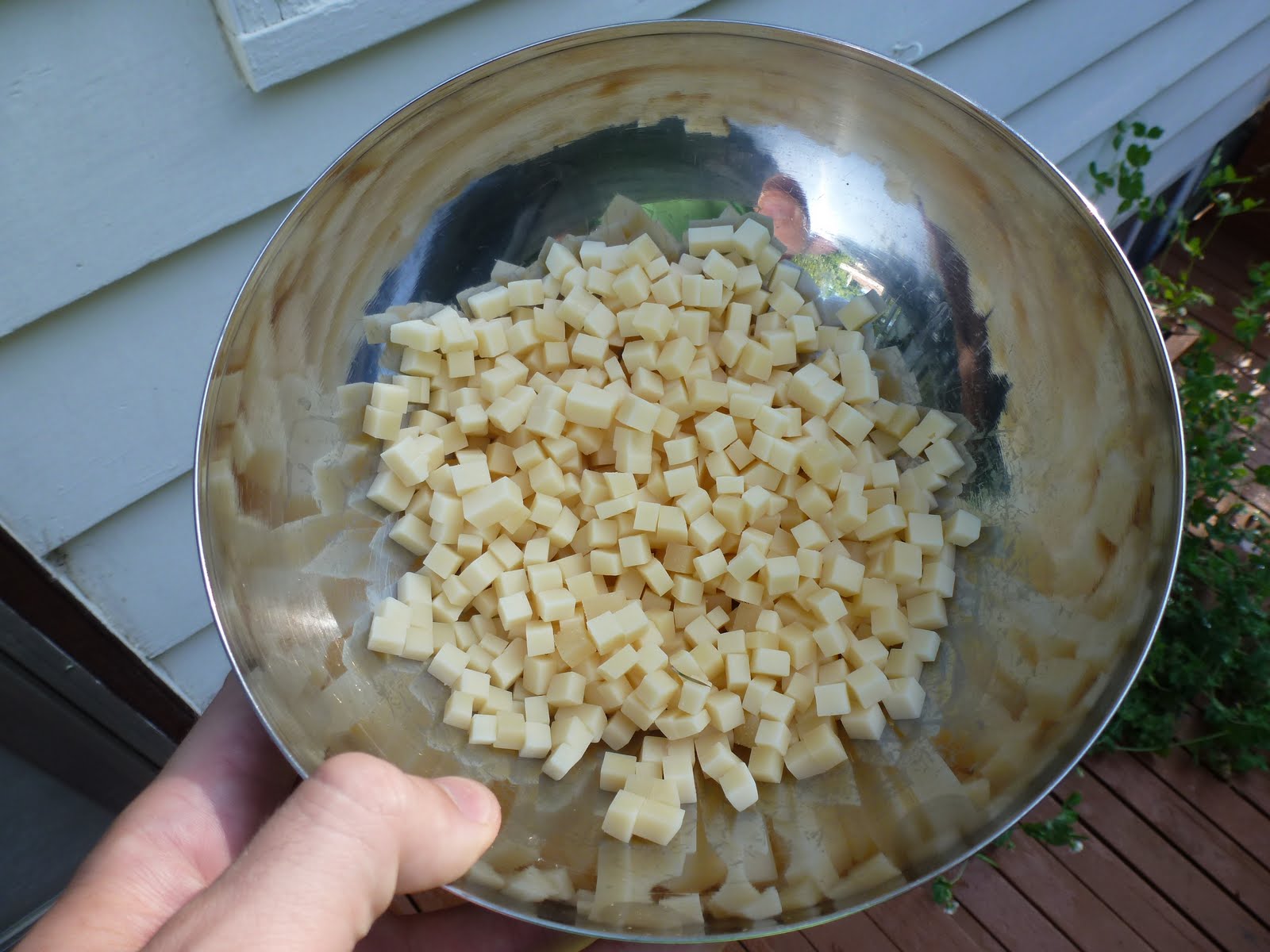
  • 200 g Sylvan Star Gruyère, rind removed, diced into 3/16" cubes
  • 16 g kosher salt
  • 1/2 tbsp light corn syrup
  • 1 pinch sodium nitrite
  • 2 cloves garlic (the Austrians call them "toes," which I thought was cute...), minced
  • 1 bay leaf, ground
  • 1/4 tsp smoked paprika
  • 1/4 tsp mustard powder
  • 1/4 tsp freshly ground, toasted coriander
  • 1 pinch cayenne
  • fresh ground black pepper
  • 5' hog casings, soaked and rinsed

Procedure

I chose to experiment with Gruyère because of its famous melting properties (it is the go-to cheese for fondue and raclette).  To my surprise, Sylvan Star has their own version of the alpine cheese:


Cut the pork into 1" cubes.  Spread on a tray lined with wax paper and keep in the freezer until "crunchy" but not frozen solid.  Grind the meat through a 1/4" plate.  Add the salt and spices to the ground meat.

Spread the ground meat onto a tray lined with wax paper and return to the freezer for about 15 minutes.  Regrind the mixture using a 3/16" plate.

Using the paddle attachment of a stand mixer, slowly mix the forcemeat while adding the corn syrup.  When the force binds and becomes tacky, fold in the cubed cheese.


Fry a small piece of the mixture and taste.  Adjust the seasoning as necessary.

Stuff the mixture into the hog casings and twist into 6" links.  Hang on a wooden dowel to dry for an hour.


On Cooking Käsekrainer

On the streets of Vienna there are actually two types of käsekrainer.  They result not from different methods of manufacture, but from different methods of cooking.

The first, when passed through the würstlstand window, looks like any other sausage; it is only upon biting into the link that you discover the cheese.  The second has a crunchy crust of cheese fried onto the exterior of the sausage.  I don't think I need to spend much time explaining why the latter is superior (the nutty-tangy taste of browned cheese, the accentuation of the textural contrast between sausage skin and interior...)

Having only cooked a couple of käsekrainer links myself, I am still working on my crust development.

Inevitably (and especially in homemade links) some cheese will leak out the ends during cooking.  My working theory on crust development is that the sausage must be rolled through this cheese while it is still gooey, so that the cheese adheres to the skin.  Otherwise the cheese will brown and stick to the pan, instead of the sausage.  As a rule of thumb, move the käsekrainer frequently while cooking.

The sausage must be eaten very hot, or the cheese will re-congeal.


This recipe and cooking process result in an acceptable approximation of an Austrian käsekrainer.  I think that most of the versions I had there were lightly smoked.  While the smoked paprika in my recipe goes some distance to capturing that flavour, I think the next test batch will have to be cold-smoked before frying.

Wednesday, July 20, 2011

Austrian Charcuterie

For starters let me say that Austrians don't use the word "charcuterie."  To some of you that may seem obvious, as Austrians speak German.  Yet for some reason most of the English-speaking world uses the French term "charcuterie."

While French words do weasel their way onto fine dining menus in Austria, they are nowhere to be found in descriptions of butchery or cured meat.  For these, Austrians have their own, precise way of speaking, belying the strength and individuality of their traditions.

In contrast, the charcuterie renaissance in North America uses of grab-bag-blend of terms from across Europe.  Bresaola (northern Italian), is mentioned in the same breath as saucisson sec (French), and jerky (Plains Indian).

Despite all this, I still use the term "Austrian charcuterie," in the hope that North Americans curious about Austrian cured meat will be more likely to stumble across this page.

Anyways.

Charcuterie has a very special place in the Austrian diet.  Breakfast, for instance, invariably consists of bread, cheese, coffee, and some form of cured meat or pâté.  The larger cities are dotted with würstlstände (sausage stands, which will be discussed in a future post).  To my mind, the greatest place to sample Austrian charcuterie is at certain taverns called heurigen.


Heurigen ("HOY-ree-gen," singular heuriger)

Austria produces a lot of wine.  Most of this wine is consumed within the country while it is relatively young, (which is why Austrian wines are very rare in this part of the world).  The word heuriger literally means young wine, but the term usually refers to a special kind of tavern.  Winemakers will open up shop for a couple of weeks so that guests can come to drink the young wine, which is served with plates of cold food such as cheese, spreads, bread, and charcuterie.  The word for these savoury accompaniments is brettljause ("BRET-tel YOW-ze").  Brett means board, as the food is usually spread out on a wooden board.  Brettl, I think, is some kind of dimunitive form, though I'm not entirely sure. Jause means snack.

While heuriger usually implies wine, there are also most heurigenMost is a type of cider, usually made from apples, though sometimes pears are used.  Most is quite different from the commercial ciders we know.  It has a pronounced sourness, and in my brief experience it is usually not heavily carbonated.  Sometimes it's straight up flat.

Since heurigen are open irregularly for short periods throughout the year, the owners will hang an evergreen bough (busch "BOOSH") over their door or signpost so that passersby will know when they are open.  For this reason, in the province of Styria, heurigen are called buschenschänken (singular buschenschank).  Schank means bar, as in the place where the bartender stands.  The implication is that the wine, intended to be drank young, is stored in barrels and poured from the bar, instead of being bottled for long storage.

I suppose the star of the heuriger show is supposed to be the wine or most, but for me the main attraction was always the charcuterie.  So, without further warbling I would like to introduce you to the main players of Austrian charcuterie, as they are served in traditional heurigen.


Blunz'n ("BLOON-tsin") - Blood Sausage

This is the infamous blood sausage, which we have toyed around with a couple times here on Button Soup.  In Germany it is called blutwurst.  In Austria it is called blunz'nAustrian blunz'n is a very different creature to English black pudding or French boudin noir.

I attribute the success of my last attempt at blood sausage to the inclusion of a panada, a mixture of milk and bread.  Austrian blunz'n is very heavy on the bread content.  In fact, the first piece I ever had was riddled with white cubes that I assumed were pork fat, but turned out to be bread.  While English black pudding has a pronounced blood taste, and a pastey texture, blunz'n is subtle and light, somtimes more like a dumpling than a sausage.


My favourite blunz'n so far had a pleasant acidity to it.  I'm not sure whether this was from added vinegar, or if maybe rye sourdough was used in the panada.


Besides being sliced for cold platters, blunz'n is surprisingly common in the kitchen.  There is a traditional dish called blunz'n gröstl, which is a blood sausage hash.  We also had blunz'n baked into an eggy bread:


Grammel ("GRAM-mel", plural grammeln) - no translation

This is a weird one, as you may have guessed by the fact that there is no satisfactory English translation.

The first time I had grammel was in a dish called grammelschmaltzbrot.  It appeared to be rendered pork fat spread on rye bread, with tiny, crunchy flakes that resembled bacon bits, only much smaller, maybe the size of kosher salt crystals.  I asked a handy Austrian what exactly I was eating.  She said, approximately, that when pork fat is rendered and then "pressed" (strained?) you are left with grammel.  I wondered aloud. Bits of skin?  Bits of meat?  She wasn't sure.

When searching the internet, I came across this explanation, which is well-written, but I think entirely inaccurate.  The author says that grammeln are mineral deposits in the fat of Mangalitzas, an Austro-Hungarian heritage pork breed renouned for its eating quality.  I don't buy this, simply because I ate plenty of grammel that was not from Mangalitzas.

By Occam's razor I'm more inclined to believe the sources that say grammel is a form of connective tissue in the fat that cooks out in the rendering process.  Whatever it is, it's crisp, golden brown, and sinfully savoury.  Its existence is all the more surprising to me because I have rendered a lot of pork fat in the last couple years, but hadn't thought to skim through the residue to look for something as small and delicous as grammel.


Grammel is also used in the kitchen.  When there is a bit of residual lard on the grammel, it binds to form a paste, which can then be rolled into a knödel (roughly, "KNUH-del," a dumpling).


Hauswürstel - ("HOWS-voors-tel", literally "house sausage," in fact just dried sausage)

Similar to French saucisson sec, this is an essential component to any heuriger spread.  The most interesting version I had contained the delicious green pumpkin seeds common in Styria.


Preßwurst - ("PRESS-voorst," headcheese)

Austrian preßwurst is very similar to our headcheese, though I would say the meat is packed much more densely (ie. there is less jelly between the pieces of meat).  Even so, it holds together extremely well, and can be sliced very thin.  It's usually doused in vinegar, then called "saure preßwurst."


Kümmelbraten (roughly "KOOM-mel-BRAT-en," literally, "caraway roast," roast pork belly)

This was a pleasant surprise: pork belly, usually lightly cured, roasted with caraway seeds, and served with the skin on.  A fantastic crunch from the crackling, which splinters into little nuggets during the slicing.


Schweinsbraten - ("SHVINES-brat-en," roasted pork shoulder)

A simple roast, sliced and served cold, is a very common brettljause.  Sometimes the meat is cured, sometimes not.  Somehow the only picture I got of a cold pork roast was this haggard slice below, which I had already prodded with my fork.


Bratlfettnbrot - ("BRAT-tel FET-en-brot," approximately "roast drippings, with bread")

One of the fantastic byproducts of roasting meat is the drippings.  They are comprised of two parts.  First is the highly gelatinous meat juices.  Second is the fat rendered from the meat.  There was a time not so long ago when every housewife would pour the hot pan drippings from a roast into a jar and keep them for later use.  The fat can been scraped off and used to sear meat.  The juices, which solidify when refrigerated, can be used to fortify pan sauces.

In Austria the whole mix, that is, the partially solidified meat juices and the rendered fat, are served as a spread.  It is called bratlfettnbrot, which is possibly the most amusing word in the Austrian language.  Or any language.

In the picture below you can see the bratlfettnbrot in the plastic jar on the right, with the spoon sticking out.  The picture is not from a heuriger, but rather at Dominik's house.  Dominik was the student Lisa and I hosted last summer.  You may remember him from the fantastic Austrian dinner he and his friends cooked for us while staying in Edmonton.


Some photos.


Heuriger meals are finished with mehlspeisen ("MAYL-shpeye-zen," literally "flour food," baked desserts) and schnapps.  Austrian baking and distilling will be covered in future posts.

Friday, June 10, 2011

Candied Lilac

A special report from Button Soup's Senior Backyard Correspondent, Lisa Zieminek


With Allan in Austria, I have been tasked with keeping him informed of what’s happening in our new yard, and documenting developments with copious photographs and notes.

A couple weeks ago, the several lilac trees scattered throughout our yard burst into full bloom, filling the air with sweet perfume.

Last year we learned that lilacs are edible.  The tiny flowers can be added to salads for a splash of color.  They can also be made into beautiful, delicate candies that last long after the blossoms have fallen from the trees and their sweet smell has left the air.  Rather than keeping the memories of spring with mere photographs, I decided to preserve a little piece of the season in candy form, to be enjoyed upon Allan’s return.

Candied Lilac

Ingredients
  • simple syrup (heat 2 parts sugar and 1 part water to 225°F, then cool to room temperature)
  • individual lilac flowers, stems removed
  • ultrafine sugar (sold as “berry sugar”)
  • patience – it's a tedious job


Using tweezers, dip the lilac flowers in the simple syrup, shake off any excess liquid, then place them onto the ultrafine sugar.  Turn the flowers in the sugar to coat all sides, or sprinkle them with sugar to achieve the same effect.  Let the flowers dry overnight, then store in an airtight container.


The candied petals look like delicate crystals – they are a beautiful garnish for cupcakes or ice cream.  They have a crunchy texture and a sweet, floral taste.  (They are flowers, after all...)


-Lisa Zieminek, Sr. Backyard Correspondent

Evergreen Syrup

A nifty trick I picked up at Looshaus, a hotel and restaurant in Kreuzberg, Lower Austria.

Pick evergreen "buds" (the small bundles of new needles that appear in late spring), simmer them in simple syrup (1:1 water to sugar), and transfer the whole mess into glass jars.  The syrup takes on a fantastic, minty, pine flavour, which the Looshaus chef says gets even better with a few months storage.  Strain the needles out before using the syrup.

Some ideas for usage:
  • sauces for game meats (think: evergreen gastrique)
  • ice cream
  • in sparkling water (beer flavoured with young spruce needles was once common in Canada...) 
  • pork brines
The same process can be used for other common backyard plants, like dandelion and elderberry.

Friday, May 20, 2011

This Summer on Button Soup...

Most of the posts on Button Soup this year have been about the Supper Club.  In case you've missed any, there have been four dinners:

The Supper Club is taking a break for the summer.  I am typing this post from Semmering, Austria, which is an hour or so south of Vienna, in a mountain pass between the provinces of Lower Austria and Styria.  I am here for one month to cook in their kitchens, and then for a second month to explore the region with Lisa.

I debated for some time whether I would write about this trip here on Button Soup.  I describe Button Soup as 'Food from Edmonton, AB' in both the geographical and cultural sense, and I've always focused on home-cooking, rather than the professional sort. I wondered if writing about Austrian kitchens, and professional ones at that, would somehow upset the soul of Button Soup.


Now that I am here, I realize that I have to write about this place.  Studying foreign cuisines teaches you about your own.  In fact, several of my past experiments have been inspired by or stolen from the food of central and eastern Europe.  For instance:
So, over the summer you can expect lots of posts about Austrian food.


Freelance Editor's Competition

I will be typing my posts on a German keyboard.  The major differences  between a German keyboard and its English counterpart are the inclusion of the 'umlauted' vowels (ü, ö, ä...), and that the 'y' and the 'z' keys are in the oppostie positions.  I can't seem to unlearn what Mavis Beacon taught me, and I am constantly typing 'zou' instead of 'you,' and 'verz' instead of 'very.'  As one of those neurotic, condescending pricks who corrects people's grammar and doesn't respect menus with spelling errors, it's extremely frustrating.

If you ever see that I have typed a 'y' where there should be a 'z,' or vice versa, be the first to comment on it and win a jar of homemade preserves.

There's one more exciting feature this summer on Button Soup.


Introducing Lisa Zieminek, Button Soup's Senior Backyard Correspondent

Lisa is my girlfriend.  We live together in McKernan.  She taught me how to cook.

While I am cooking in Austria, Lisa will be closely observing the growth of the edible plants in our backyard in Edmonton.  She will periodically post about some exciting kitchen preparations of those plants.

It's going to be a busy summer.  Stay tuned...

Monday, May 16, 2011

Dandelion Salad

At left is the first harvest from the yard, largely rhubarb and dandelions.

When picked young dandelions are tender and bitter, with a slender red stalk. Classically, they are often served with bacon, garlic croutons, hard-boiled egg, and vinaigrette.

Here's a variation on that theme.

Firstly, in addition to the greens, this year I gave the roots and flowers a go.  The roots have the same bitterness as the leaves, obviously with an added crunch.  The flowers are very fun to eat.  They have a slight sweetness

Instead of the classic hard-boiled egg I used a soft-poached quail egg.  When broken, the yolk runs through the leaves and tempers their bitterness.

The dressing was made with cider vinegar, a touch of mustard, a touch of bacon fat, and canola oil

Instead of bacon I used pig's ear.

I should tell you a bit about pig's ear.

When I make headcheese, I simmer the entire head of the pig.  To make the soft, creamy version of headcheese that I enjoy, I include mostly the jowl fat and the tender meat.  I exclude parts of the head that will conflict texturally, notably the ears, which have cartilage in the them.

Since they have been simmered extensively, these bits of ear were coated in seasoned flour and fried crisp.

At first bite, the fried ears are not much different than crispy bacon. Once you reach the centre there is the distinct crunch of the cartilage.  A very interesting eating experience.

This salad goes well with weissbier.


Saturday, May 14, 2011

Perennials Bequeathed

In January, Lisa and I bought a house in McKernan.  The backyard was a gift that spring has recently unwrapped for us.  Over the last couple weeks we've discovered that the previous owners of this house were active gardeners who established a mass of edible perennials.

Following are the edible plants that are appearing in our yard.  If you think we've misidentified anything, please let me know.  (We're new at this...)


Strawberries


Apples


Horseradish


Juniper (with mature berries)


Raspberries (lots of raspberries...)


Rhubarb


Cherries?


Currants?