Showing posts with label Rabbit. Show all posts

Tuesday, April 26, 2011

Button Soup Easter Dinner

The April installment of the Button Soup Supper Club was an Easter Dinner with Lisa's family, featuring some of the traditional, symbolic ingredients and dishes discussed earlier.  The menu:


Hot Cross Buns

Potted Rabbit, Crackers, and Cheese

Young Spinach with Bacon and Quail Egg

Smoked Ham with Scallop Potatoes

Oat Cake in Maple Syrup


Hot Cross Buns


Potted Rabbit, Crackers, and Cheese

Butchering Rabbits: a "break" from tradition

Rabbits are not usually butchered by neatly separating the joints, as you would a chicken.  They are broken into forequarters, hindquarters, and a saddle by cleaving right through the bones.  Chefs often bitch about how tedious butchering rabbits is, "especially since there's practically no meat on them."  Their words.  Not mine.

The problem with cleaving is that you're bound to splinter the bones.  I've bitten down on a fragment of rabbit bone in restaurants more than once.  Taking the time to properly butcher the rabbit by cutting through the joints and not breaking the bones minimizes the chances of choking someone.  It also shows that you care about your ingredients and take your job seriously.  Anyways...

Below, from top left: hindlegs, caul fat, kidney, heart, liver, tenderloins, forelegs, loin with belly attached.


The meat was confited and pulled...


..then potted.


I hope that the lady who invented Raincoast Crisps has made her fortune, because imitations are now everywhere I look: supermarket shelves, online recipes, restaurant cheese plates, as well as my kitchen.
Raincoast Crisps are made by baking a loaf flavoured with dried fruit, nuts, and herbs, then thinly slicing that loaf and baking it for a second time to make crackers.  Like I said, recipes abound online.  This one is my favourite.


The finsihed plate: potted rabbit, dried fruit crackers, Sylvan Star smoked gouda, and Smoky Valley Valencay.


Salad

Quail eggs!


A very fatty slab of bacon


Young spinach (which costs a fortune at the market at this time of year, but can be got...), hard-boiled quail eggs, bacon, onion, and vinaigrette.


Smoked Ham with Scalloped Potatoes

Problems with Brine Penetration

Even working from Ruhlman's recipes for ham, I always (always!) have problems with brine penetration.  With any ham larger than a hock, it seems that no matter how long I leave the meat in the brine, the brine can't reach the middle of the cut, closest to the bone. I might have to start injecting the brine deep into the meat...


Oatcake in Maple Syrup

This dish showcased this year's maple syrup.  A simple oatcake was baked, then cut into squares and cooled.  The baking dish was then filled with hot maple syrup, which the cake soaked up like a sponge.  Essentially a lazy man's pouding chômeur (a lazy man's poor man's pudding?)

Served with ice cream. 


Wednesday, April 21, 2010

Rabbit Pie: A Detailed Description

'Now, my dears,' said old Mrs. Rabbit one morning, 'you may go into the fields or down the lane, but don't go into Mr. McGregor's garden: your Father had an accident there; he was put in a pie by Mrs. McGregor.'


Rabbit pie made with meat from Trowlesworthy FarmsAfter stewing the choice legs and loins of a Trowlesworthy Farms rabbit, I found myself with a lot of trim. Most notable were the forelegs, the belly-flaps from the saddle, and the kidneys. Besides this there was miscellaneous trim pulled from the carcass. I decided that this would become a rabbit pie.


Making the Recipe

A classical rabbit pie (and yes, rabbit pie is a classical preparation...), would use lean rabbit meat and pork fatback, not rabbit fat. In fact, most non-pork charcuterie preparations call for lean meat in conjunction with pork fat. For instance, a sausage made of chicken or duck would be three parts lean poultry meat, trimmed of all fat, and one part pork fat. This is because pork fat has a creamy, pleasing texture, and a fairly neutral flavour. When cleaning the rabbit carcass, I was left with a surprising amount of beautiful, white fat, especially around the kidneys. I decided for the sake of experimentation and frugality to use this fat in a rabbit forcemeat. Separating the lean flesh from the white fat, I found I had:
  • 575g lean rabbit meat
  • 325g rabbit fat
This is roughly a ratio of 5:3 meat to fat. Most sausages have a ratio of 3:1, but several rich sausages like weisswurst use a higher percentage of fat. I found a rich bratwurst recipe that uses a 5:3 ratio, with milk and eggs for further luxury. I based my rabbit pie forcemeat on this recipe.

The Process


With the meat, cream, and egg in the bratwurst recipe, my forcemeat is very much like a mousseline. For a smooth texture and good emulsification of meat and fat, mousselines are usually mixed in a food processor.
I don't own a food processor (and a recent trip to Sears to look at prices confirmed that I will not own one any time soon...) Instead of processing, I used progressive grinding, then a thorough mixing to distribute the cream and egg and develop the meat protein.

The Results


When I fried a quenelle to test the seasoning, the forcemeat tasted great and had a pleasant, light, mouthfeel, though the texture was not perfectly smooth. Every so often there were tiny flecks with a gristly feel. They didn't ruin the meat for me: in fact, once the onions, prunes, and pie crust came into the picture, I didn't even notice them. But if the forcemeat were to be served as a simple boudin blanc, these gristle-bits would definitely draw attention.

I've racked my brain to figure out where exactly these bits came from.
There was definitely some skin in the meat trim that I didn't remove, but the bits had an almost fibrous quality that I don't think skin would have. Ultimately I must have missed some sinews in the meat, but I can't imagine where they would have been.

My trim problem will have to be solved, but the recipe itself was a success. The delicate meat, the fruit, the sweet quatre epice, and the buttery, flaky pie crust all married happily. I'll definitely be making this again. The (almost) complete recipe and process are below.


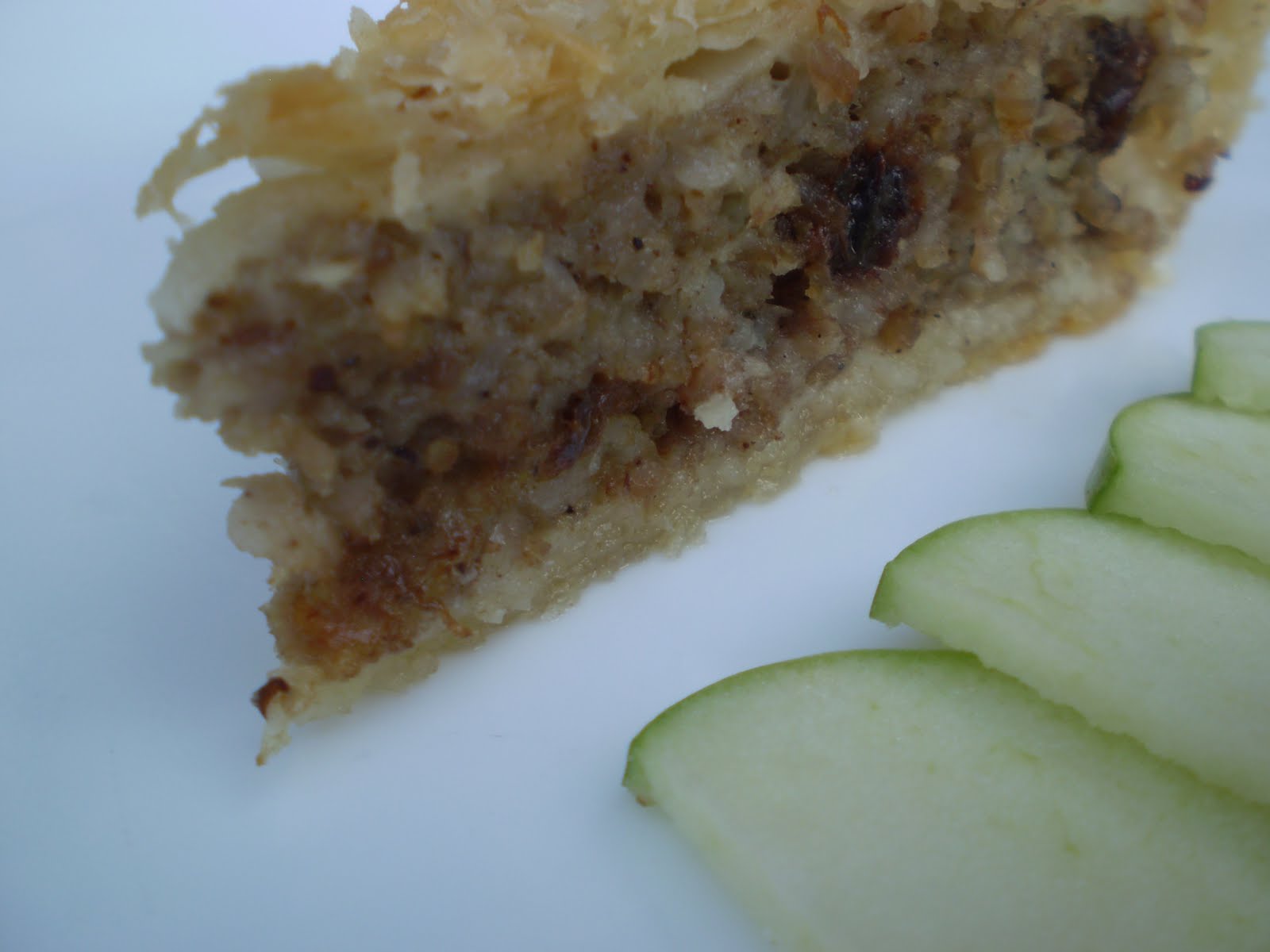
A slice of rabbit pie with granny smith apples.Rabbit Pie

Forcemeat
  • 500g lean rabbit meat
  • 300g rabbit (or pork) fat
  • 15g kosher salt
  • 100mL heavy cream
  • 1 egg
  • 1.5 tsp quatre epices (recipe below)
  • 60g onion, brunoise
  • 60g prunes, chopped
Pie Crust (makes enough for two rounds, top and bottom)
  • 360g flour, sifted
  • 240g butter
  • 120mL cold water
  • pinch of salt
Quatre Epices
  • 2 parts black pepper
  • 1 part cinnamon
  • 1 part nutmeg
  • 1 part clove
  1. Combine meat, fat, salt, and quatre epices. Keep mixture very well chilled while flavours combine.
  2. Gently sweat onions and cool very well.
  3. Prepare the pie crust.
  4. Taking all usual precautions to keep meat and equipment cold, grind meat mixture through medium plate.
  5. Grind meat mixture through small plate.
  6. Mix with paddle attachment on lowest setting for one minute. Beat egg into cream. Slowly add to forcemeat. Increase speed to Level 2 and mix another minute.
  7. Fold in chilled onions and chopped prunes.
  8. Saute a small portion of the forcemeat to test seasoning.
  9. Spread forcemeat into pie crust. Top with second crust.
  10. Bake in 350F oven until meat reaches 180F and pie shell has browned.
Serving suggestion: with apple slices. A little aicidity to cut the fat. Plus apples and quatre epices are good buddies.

Sunday, April 18, 2010

Rabbit

Trowlesworthy rabbit with prunesOur 2008 trip to Greece was full of culinary firsts. Besides specifically Greek wine, spirits, candy, and breads, I also had inaugural tastings of fresh figs, rooster, octopus, and rabbit.

Even before I went, I knew that I was going to eat rabbit in Greece. It was on my to-do list. At the time, I put rabbit in the same category as brains and shark meat. Even though I see more rabbits in a given day than cows, from a culinary perspective, rabbit was very exotic.

Finally, at a beachside taverna on Syros, I ate my first rabbit dish. I was served one hind leg with tomato sauce and potatoes. Frankly, I was underwhelmed.

Before leaving for Greece, people were so shocked when I mentioned that I planned to eat rabbit, I expected the meat would have some kind of jarring, gamey taste to match. The truth is, it has more bite than chicken, but not as much as pork, and a very mild flavour. Don't misunderstand me: it's good meat. I was just... surprised.

Rabbit plays a fairly important role in traditional Greek cooking. A meat stew called stifadho, which is practically the national dish of Hellas, was until recently most often made with rabbit and pearl onions. Rabbit meat appears in several other dishes, often paired with fruit, especially currants and prunes.

One of our favourite restaurants in Greece was Portes, in Hania, Crete. "Portes" means "doors", and the stone walk approaching the taverna is lined with brightly painted wooden doors, leaning against an adjacent fence. After our meal, the bill came with a recipe for rabbit with prunes printed on a souvenir bookmark. Lisa and I have been talking about cooking rabbit ever since then, and this week, with Greek food on the brain, we finally did it.

Buying Rabbit in Edmonton


During the weeks approaching Easter, the Trowlesworthy Farms booth at the Strathcona farmers' market displayed a small sign advertising rabbit for sale. It had a cartoon bunny on it that might have been ripped from a child's colouring book. It seems that our pastoral, childhood associations with rabbits are inevitable, even when dealing with an eviscerated rabbit carcass. (For more on this topic, read this Rob Mifsud blogpost, the truly shocking reader comments that follow, and Anthony Bourdain's response, called The Lessons of Bunnies.) This was the first time I had seen rabbit at the farmers' market. It was no doubt brought in as an Easter special, but I am sure you could order one any time of the year. I also know that certain butcher shops, like Easyford, will order in rabbits at your request.

Here is how we prepared our Trowlesworthy bunny.

Rabbit with Prunes
Adapted from a recipe by Susanna Koutoulaki of Portes restaurant, Hania, Crete

  • 1 rabbit, cut in pieces
  • 1/2 large onion, diced
  • 2 cloves garlic, minced
  • 2 bay leaves
  • 400mL white wine
  • 1 bowl prunes
  • 2 tbsp of brandy (Metaxa would be appropriate...)
  • 1 tbsp paprika
  • salt and pepper

  1. Soak the prunes in water.
  2. Brown the rabbit pieces in oil. Remove from pan.
  3. Sweat onions, garlic, and paprika.
  4. Deglaze pan with brandy and wine. Cook off alcohol.
  5. Return rabbit to pan. Add bay leaves and prunes, with their soaking water.
  6. Cover and simmer until rabbit is tender, at least an hour.
  7. Serve on rice.
A Note on Cutting up Rabbit

Traditionally rabbits are segmented as follows: the two forelegs, the rib section, the saddle (the backbone with the two loins, two tenderloins, and two "side flaps"), two hind legs, and tail section. In a rustic preparation, all these parts, with bones, would be thrown into a stew. I didn't feel like picking through bones while eating, so I only included the hind legs, each separated into two, and the loins, cut into stew-sized pieces. The rest, including the meaty side flaps and kidneys, I reserved for a future project.