Showing posts with label Supper Club. Show all posts

Tuesday, September 20, 2011

Button Soup Canning Bee


Until recently the only bees I knew of were honey bees, spelling bees, and quilting bees.  There was a time when there were many other types of bees.  Canning bees, for instance.

A "bee" is any gathering with a task in mind.  In the days of yore it was often implied that people were coming together to help one person or family accomplish a large task in a relatively short amount of time.  In rural Canada a community might gather to help a family thresh all their grain.  Another threshing bee might be held the following week at a different farm.

A family history book tells me that food and whiskey were provided to those who helped.  That same family history cautioned not to serve the whiskey until the chores are done.


The Button Soup Canning Bee

After a summer hiatus for my trip to Austria, the Button Soup Supper Club returned in September.  A group of ten friends helped me put up a large amount of preserves, and were then treated to a large spread for dinner.

Preserves included dill pickles, pickled onions, onion marmelade, beet relish, figgy mustard, highbush cranberry sauce, pickled garlic (cloves and scapes), and piccalilli.  For those unaware, "piccalilli," at left, is just relish, made with a wide assortment of vegetables instead of just cucumber. My mother's family always made it with green tomatoes.   This particular batch used overgrown zucchini, bell peppers, and onions.


 Preserving Mountain Ash (Don't...)

Besides the more familiar preserves listed above, we also made some experimental batches of mountain ash jelly. A botanist friend has ensured me, time and time again, that our mountain ash are edible. I've finally conceded that they may be safe to eat, but they aren't worth eating.

I hate to say that, because we had people cleaning and processing mountain ash all day, but the fact is that the berries are just too soapy and bitter.  We even tried a traditional Scottish recipe for rowan jelly in which the whole, uncrushed berries are gently simmered, supposedly to minimize the extraction of soapy flavours, but the resulting liquid was still inedible.


Crushing Apples with a Meat Grinder (Don't...)

We also crushed and pressed another round of apples that day.  On the recommendation of an internet site, instead of using a proper crusher, we tried a large meat grinder. It didn't work very well. The grinder worm wasn't able to put the apples through the machine, so we had to force them through with the plunger.  We ended up crushing the apples more with the plunger than the blade of the grinder.  It took forever.  Never again.


Dinner

Part way through the afternoon we pulled out the hard cider, which was in its bubbly, alcoholic, sweet spot.

For dinner, since the kitchen was tied up with people chopping vegetables and boiling jars, we ate simple dishes that could be prepared well in advance.

First was headcheese, ideal for serving large groups because a) it's cheap as nails, and b) it can be made the night before and simply sliced to order.  Taken with pumpkin seed oil and cider vinegar.


Next we put out some roasts: pork shoulder, pork belly, and beef eye of round.  Sliced and served on crusty buns with coleslaw and homemade potato chips.

A jar of each preserve was set out to sample with the sandwiches.


Dessert was sour cherry pie and vanilla ice cream.


Thanks to those who helped out.  I have you all scheduled for next September.

Tuesday, April 26, 2011

Button Soup Easter Dinner

The April installment of the Button Soup Supper Club was an Easter Dinner with Lisa's family, featuring some of the traditional, symbolic ingredients and dishes discussed earlier.  The menu:


Hot Cross Buns

Potted Rabbit, Crackers, and Cheese

Young Spinach with Bacon and Quail Egg

Smoked Ham with Scallop Potatoes

Oat Cake in Maple Syrup


Hot Cross Buns


Potted Rabbit, Crackers, and Cheese

Butchering Rabbits: a "break" from tradition

Rabbits are not usually butchered by neatly separating the joints, as you would a chicken.  They are broken into forequarters, hindquarters, and a saddle by cleaving right through the bones.  Chefs often bitch about how tedious butchering rabbits is, "especially since there's practically no meat on them."  Their words.  Not mine.

The problem with cleaving is that you're bound to splinter the bones.  I've bitten down on a fragment of rabbit bone in restaurants more than once.  Taking the time to properly butcher the rabbit by cutting through the joints and not breaking the bones minimizes the chances of choking someone.  It also shows that you care about your ingredients and take your job seriously.  Anyways...

Below, from top left: hindlegs, caul fat, kidney, heart, liver, tenderloins, forelegs, loin with belly attached.


The meat was confited and pulled...


..then potted.


I hope that the lady who invented Raincoast Crisps has made her fortune, because imitations are now everywhere I look: supermarket shelves, online recipes, restaurant cheese plates, as well as my kitchen.
Raincoast Crisps are made by baking a loaf flavoured with dried fruit, nuts, and herbs, then thinly slicing that loaf and baking it for a second time to make crackers.  Like I said, recipes abound online.  This one is my favourite.


The finsihed plate: potted rabbit, dried fruit crackers, Sylvan Star smoked gouda, and Smoky Valley Valencay.


Salad

Quail eggs!


A very fatty slab of bacon


Young spinach (which costs a fortune at the market at this time of year, but can be got...), hard-boiled quail eggs, bacon, onion, and vinaigrette.


Smoked Ham with Scalloped Potatoes

Problems with Brine Penetration

Even working from Ruhlman's recipes for ham, I always (always!) have problems with brine penetration.  With any ham larger than a hock, it seems that no matter how long I leave the meat in the brine, the brine can't reach the middle of the cut, closest to the bone. I might have to start injecting the brine deep into the meat...


Oatcake in Maple Syrup

This dish showcased this year's maple syrup.  A simple oatcake was baked, then cut into squares and cooled.  The baking dish was then filled with hot maple syrup, which the cake soaked up like a sponge.  Essentially a lazy man's pouding chômeur (a lazy man's poor man's pudding?)

Served with ice cream. 


Sunday, March 20, 2011

Button Soup St. Patrick's Day Dinner

The Button Soup St. Patrick's Day Dinner was a North American-style observance of the holiday: a celebration of Irish heritage, generally, and not a commemoration of the saint. Even so, there were no cartoon leprechauns, no buckled top hats, and no green beer. Instead there were four courses based loosely on traditional Irish dishes, lots of alcohol, music, and some readings from Irish writers.
By chance, I was cooking four dishes that I have posted about in the past. Descriptions follow. All "Hipstamatic photos" are courtesy of Andy Grabia, a true son of Erin (his aversion to brawn notwithstanding). Thank you, again, Martin Kennedy, for playing host.


Brawn, Clover, Buttermilk

Brawn is the British word for headcheese, the preparation of which I wrote about here. In that post I mentioned that the brawn would look much, much better if the meat were first brined; it would be rosy pink, instead of questionable grey. This time around I did a proper brine of kosher salt, curing salt, and brown sugar.


I cut the jowl and tongue into tidy cubes that were white and red, respectively, while shredding the rest of the head meat. I enjoyed this incarnation of the headcheese much, much more than the last. Unfortunately the dish wasn't received enthusiastically. The modern eater has a serious problem with meat jelly.

The brawn was garnished with clover shoots. I thought serving clover on St. Paddy's day was a fantastic idea. Besides the obvious Irish connection, it seemed appropriate to serve sprouts at a time of year when we we're sprouting our seedlings indoors, waiting for the snow to melt (see left). Judy bought a bag of red clover from a seed vendor, who was mildly disgusted when she found out we were going to eat the sprouts ("Clover's cow food!"). The shoots are almost indistinguishable from alfalfa. They taste fine on their own, but honestly they didn't add much to the dish.

Sprouting is dead simple.  Just soak the seeds in water overnight, then drain and rinse twice a day until they grow to the desired maturity.  We kept our seeds in a glass jar with a nylon stocking stretched over the mouth.  Water can be poured through the stocking to rinse the sprouts, then the glass can be inverted to drain the water away.


Headcheese is beautiful - visually and conceptually - and it pains me as a professional cook that I will probably never be able to prepare this to an appreciative audience.

 
The sauce was mayonnaise made with egg yolks and cold-pressed canola, thinned out with buttermilk for a bit of tang, and spiced with cayenne and mustard.


Potato Broth, Dumplings

I first wrote about potato broth here. The basic idea is to steep potato skins in vegetable broth to infuse the liquid with the distinct flavour of potatoes. This particular version didn't work out too well.  The broth didn't take the flavour of the skins, possibly because I boiled the potatoes before peeling them, instead of roasting them as I did last time.


Black Pudding, Colcannon, Apples

Black Pudding is the British word for blood sausage, the preparation of which I wrote about here. In that post I mentioned that the filling didn't bind properly: the cooked sausages crumbled when sliced. This time I tried a recipe from the Au Pied de Cochon Cookbook. My only departure from Picard's recipe was using oat flour instead of chestnut flour. The major difference between this recipe and the last is the inclusion of a panada, which is bread soaked in milk. The final sausages held together beautifully, and were tender and smooth to boot. This is now my default blood sausage recipe. Thank you, Martin.

Colcannon is a mix of mashed potatoes and cabbage or kale. My colcannon is mashed potatoes heated in some of the brawn cooking liquid and butter, then mixed with shredded cabbage that has been braised in cider vinegar and bacon fat.

After the black pudding rounds were seared in a skillet, slices of Granny Smith were cooked in the same pan.


Whiskied Fruitcake, Hard Sauce

My computer is trying to tell me that "whisky" isn't a verb. How frustrating. I made fruitcake for the first time this past Christmas, and wrote about it here.


Fruitcake is a very common dish in Great Britain, even outside the Christmas season.  This particular manifestation was made with orange peel, walnuts, and raisins. I soaked the baked cake in Jameson's. Though appropriate to the St. Paddy's Day theme, Irish whisky is much less aromatic than rum, and not great for flavouring baked goods.

The cake was dressed with a classic hard sauce: two parts icing sugar cooked out in one part butter, then finished with Jameson's and egg.


Other Notes from the Dinner: Alcohol and Literature

 That's protestant whiskey!
-McNulty on Bushmills, in The Wire


As you might expect, alcohol played an important part in the dinner. I was thoroughly razzed for bringing Bushmills ("Protestant whiskey"), though it was appropriate to my Orange heritage.

There's a big difference between Scotch and Irish whiskey.  The malted barley used in Scotch is dried over peat fires, and after fermenting, is twice distilled. Traditional Irish whiskey doesn't have any of the smoky, peaty notes of Scotch, and is thrice distilled for a smoother taste. Mel Priestley recently wrote a brief but informative article for Vue Weekly on the history of Irish whiskey.  Thank you, Mel.

The real star of the show was Redbreast Irish whiskey. Very, very smooth.  Heavy on the butterscotch.  Delectable.


Obviously there was Guinness.

I can't imagine that Joyce was a willing celebrant of St. Patrick's Day, but he still made an appearance at our dinner.


Now, at the name of the fabulous artificer, he seemed to hear the noise of dim waves and to see a winged form flying above the waves and slowly climbing the air.  What did it mean?  Was it a quaint device opening a page of some medieval book of prophecies and symbols, a hawklike man flying sunward above the sea, a prophecy of the end he had been born to serve and had been following through the mists of childhood and boyhood, a symbol of the artist forging anew in his workshop out of the sluggish matter of the earth a new soaring impalpable imperishable being?

 
Welcome, O life! I go to encounter for the millionth time the reality of experience and to forge in the smithy of my soul the uncreated conscience of my race.

Thursday, March 17, 2011

St. Patrick's Day

I have only a tenuous claim to Irish ancestry. While I do have ancestors who lived in Ireland proper, they were Orangemen (Anglo-Saxon protestants, at left...)  I don't think I have any Celtic blood in my veins.

St. Patrick's Day, now one of the kitschier holidays we celebrate, has been completely divorced from its origin.  March 17 is actually the Catholic feast day for St. Patrick, the patron saint of Ireland.  The details of St. Patrick's life are often debated, but the popular traditions and stories are more important than the historical facts.  It is the legend of St. Patrick that has informed the beliefs and practices of Catholics for more than a thousand years.  The legend is truer than the truth.


Patrick was probably born in Scotland, but at a young age he was captured by pirates and sold into slavery to an Irish chieftain. He escaped, became a priest, and later returned to Ireland as a bishop.  He is commonly said to have converted the Irish to Christianity.  Though he no doubt won many converts, it is more likely that he was sent to maintain an existing Christian community.
 

Patrick explained the holy trinity to his followers using the three leaves of the shamrock, which also happened to be a sacred plant to the Druids.  This is an example of Christianity adapting by blending with pagan culture (something we will discuss a lot more when we get to Easter...)

Patrick is also said to have banished all snakes from Ireland after they disturbed him during fasting and prayer. There is an old wives' tale that a snake will never slither over a trefoil (ie clover).  I'm not sure whether this belief predates St. Patrick, and the snakes left Ireland because of the bounteous clover, or if they now avoid clover because it reminds them of St. Patrick.  I've heard the story told both ways.

March 17 is the anniversary of Patrick's death. 


Button Soup St. Patrick's Day Dinner

An old joke: I'm giving up drinking for Lent, and I'm giving up Lent for St. Patrick's Day
  

What is interesting about St. Patrick's Day, given our focus on feasting and fasting, is that it is often excused from the rigors of Lent. In all of Ireland and in most diocese in North America, St. Patrick's Day is formally exempt from Lent, and Catholics can indulge in meat and alcohol and dancing and all the other revelry normally forbidden at that time of year.

The March installment of the Button Soup Supper Club was an Irish dinner for the Feast of St. Patrick, graciously hosted by Martin Kennedy of the Garneau district.  It featured some traditional Irish fare, with a special emphasis on breaking the Lenten fast for one night.  Full recap to follow.

Button Soup St. Patrick's Day Dinner

Bill of Fare

Brawn, Clover, Buttermilk

Potato Broth, Dumplings

Black Pudding, Colcannon, Apples

Whiskied Fruitcake 

Saturday, March 5, 2011

Sugar Pie, and Tapping Maples in Edmonton(?)

The final course of the Button Soup Pork Dinner was sugar pie. If you are unfamiliar with this dish, let me introduce you by way of an aimless personal anecdote. If you are familiar with the dish, you can skip the next paragraph.

My father's family lives near Ottawa, my mother's near Sudbury. When I was little my family would sometimes drive between these two sets of relatives, following the Ottawa River valley, where there are lots of French communities, even on the Ontarian side of the border. Along the way we would always stop at a diner called Valois in the French town of Mattawa. For dessert they offered "sugar pie," a tidy translation of tarte au sucre. While some versions of sugar pie are made with corn syrup or molasses (
imagine a pecan pie without the pecans), I think the word "sugar" actually implies maple syrup, just as easterners might call a grove of maple trees a sugar bush, and the building where syrup is made a cabane à sucre, or sugar shack. Basically the dish is maple syrup thickened with flour and eggs, set in a pie shell.

This particular incarnation was a light, slightly sticky maple pudding in a short crust. In fact, the custard was so loose that if a slice was left to stand, the filling slowly ran onto the plate.


Sugar Pie

For the shell, bake off your favourite rich, short dough in a 10" French tart pan. I use the recipe from the CIA's Baking and Pastry text.
Be sure to dock and weight the dough while baking. Cool the shell thoroughly.

Ingredients
From The Canadian Living Cookbook

  • 500 mL maple syrup
  • 100 mL all-purpose flour
  • 250 mL cold water
  • 4 egg yolks, lightly beaten
  • 50 mL butter
Whisk the flour into the water, then stir this mixture into the maple syrup. Whisk in the egg yolks. Cook over low heat until thick. Stir in the butter. Pour into expectant pie shell. Chill thoroughly. Eat with whipped cream.


Tapping Maples in Edmonton: A Fool's Errand?


Even though maple syrup is popularly described as a "Canadian" ingredient, I consider it a highly regional specialty within Canada, as it's only made on a large scale in Eastern Ontario and Quebec. In contrast to the sugar maples that grow down east, the maple trees around Edmonton produce less, and less sweet, sap. Birch and elm can also be tapped for sap, but they have even lower yields.

These facts notwithstanding, I have a perverse obsession with maple syrup (one of my favourite desserts of all time is pouding
chômeur) as well as an abstract, academic nostalgia for the ingredient. Granulated sugar is one of the few highly refined products that I use regularly, and I'm interested in finding ways to replace it with, say, honey and maple syrup. Consider this:

For the colonists, maple sugar was cheaper and more available than the heavily taxed cane sugar from the West Indies. Even after the Revolution, many Americans found a moral reason for preferring maple sugar to cane; cane sugar was produced largely with slave labor. Toward the end of the nineteenth century, cane and beet sugar became so cheap that the demand for maple sugar declined steeply.[1]

Besides all this, making
maple syrup has an extremely low effort-to-benefit ratio: by drilling a hole in a tree and boiling the sap that leaks out, you can enjoy one of the great pleasures of the table.

Lisa and I are in the process of moving to a new house. Right now the backyard of that new house is a bit like a wrapped birthday present. The wrapping is the three feet snow that currently conceal the features of the yard. There are small tears in the wrapping, if you will: the tops of wooden stakes, promising some manner of garden; shrunken, frozen apples on one of the trees; and best of all, clinging to the topmost branches of a tall tree, those winged seed pods that fall to the ground spinning like propellers. Maple keys.

I resolved to tap this maple tree, though it is most likely of the low-sugar variety. I have only the most basic idea of how to do this.

  • Tap the tree when the sap is running. The sap runs during the spring thaw, when the days are warm and nights are cold. I thought that these conditions started last week, as there were two very warm days of rapid thaw. Then it started snowing again...
  • To tap the tree, drill a hole that is slightly smaller than the diameter of your spile (the metal spigot). The hole should go 2-3" into the trunk, at a 10-20 degree incline, anywhere 2-6' from the ground. Apparently south-facing holes have a higher yield in the earlier weeks of the sap run.
  • Lightly tap the spile into the hole and hang a bucket to collect the sap.
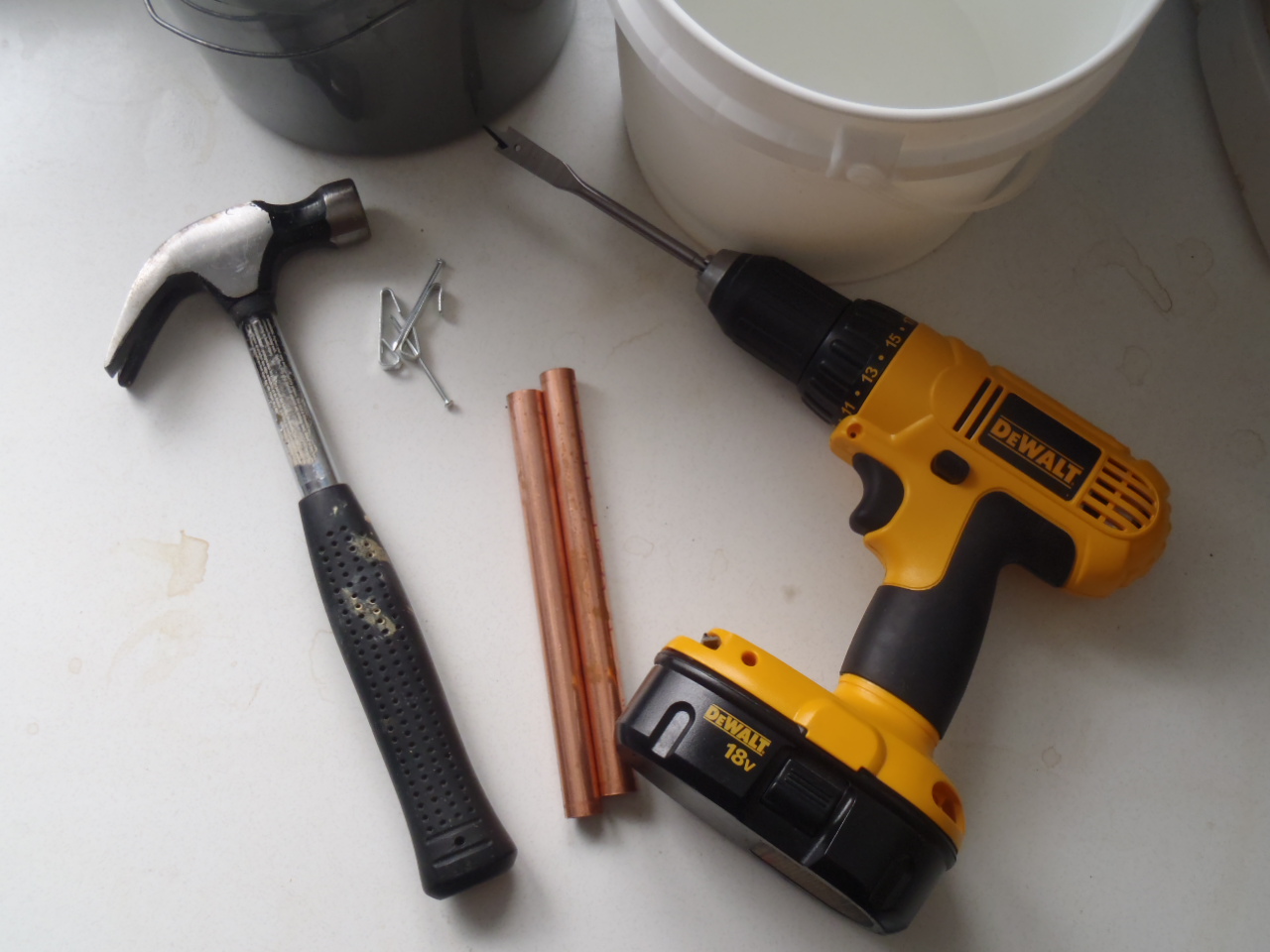
If I end up with even an ounce of syrup by the end of this, I'll be sure to buy proper spiles and buckets. In the meantime I'm using some 1/2" copper pipe from the plumbing section of the hardware store, and a plastic bucket supported by a wall hook. I covered the bucket with a plastic bag so that nothing falls into the sap.

Now we wait. Hopefully my premature tapping doesn't affect the process. I need a better almanac.

I'll keep you posted.


Reference


1. McGee, Harold. On Food and Cooking. ©2004 Scribner, New York. Page 668. I love this book.

Thursday, March 3, 2011

Stuffed Trotter

Pig's trotters were a bit of a mystery to me until recently. Before the Button Soup Pork Dinner, I had only ever used them in stocks and soups. With so many joints and cartilage, the feet release large amounts of gelatin when simmered, giving the final broth a rich mouthfeel. However, once the feet had delivered their gelatin payload, I always picked them out of the pot and threw them away.

Then I started coming across dishes in which the trotter itself is eaten, notably in the fantastic BBC mini-series Marco. The series, which I think is from the late 1980s, though I don't know exactly what year, is a glimpse into the kitchen at Harvey's, a London restaurant where the chef Marco Pierre White was setting the British cooking scene ablaze. Marco is precocious, demanding, and eloquent. The show is so beautiful it makes grown line-cooks weep (gaudy 1980's plating notwithstanding).

Anyways, in the episode entitled "Marco cooks for Raymond Blanc," Marco prepares a dish called trotters Pierre Koffmann: a boned pig's foot stuffed with chicken mousseline, veal sweetbreads, and morel mushrooms. I wondered: when you eat a trotter, what exactly are you eating? Is there meat to be had? I resolved to cook them myself and find out.
The trotter dish for the Button Soup Pork Dinner was based on Marco's, but with a simpler stuffing: potatoes and morels.


Preparing the Trotters

As with all the cuts used in this dinner, the trotters were torched to remove the remaining hairs. This is how one of the cleaned trotters looked:


Next came the removal of the long foot bone. There is footage of Marco boning a trotter in the above mentioned "Marco Cooks for Raymond Blanc". You can watch it here. It takes him about ten seconds.

An incision is made along the back of the trotter, and the skin is then cut away from the bone.


Be extremely careful not to nick the skin with the knife. When you cook the trotter, small cuts will open and become large holes. Continue to remove the skin until you reach the joints where the two outside claws connect to the foot. Cut through these joints, then snap the joints on the two central claws by bending them. It takes a bit of muscle. Sever the broken joint with your knife.

You are left with a sheet of skin attached to four little toes.


Cooking the Trotters


I cooked the boned trotters in a mixture that was one part light chicken stock and one part brown ale, with a handful of mirepoix thrown in for good measure. Simmer the trotters very gently for about three hours. It's important to cook the trotter thoroughly without overcooking. If you simmer too long, the sheet of skin will fall apart, and you won't be able to stuff it.

When the trotters were done I strained the cooking liquid and reduced it to make a sauce for the finished dish. A dark, malty, and slightly bitter sauce.


The Stuffing

Reconstitute the morels by soaking them in cold water. Save the soaking liquid; it's almost as valuable as the mushrooms themselves.

Peel some starchy potatoes, cut them into manageable cubes, and simmer until tender. Mill the potatoes while still hot.

Add oil to a hot pan. Sauté the morels. Add some finely diced onion, lower the heat, and cook until translucent. In a separate pot, bring a small amount of the morel soaking water to a boil. Add the milled potatoes. Stir while adding several cubes of butter. Fold in the morels and onions and season the mixture.

Fill the feet with the potatoes. Wrap the feet first in caul fat, then in foil or plastic. Leave the wrapped trotters in the fridge overnight. They'll set, and be much easier to work with the next day.


Interlude: Braised Cabbage with Cured Jowl

The accompaniment to the stuffed trotter was braised cabbage, the foundation of which (in my house, anyways) is always bacon fat and onions. As I mentioned in the first post about this dinner, I was working with two pig's heads. One became the bathchaps, while from the other I harvested the jowls, tongue, and ears. The jowls were cured and dried, and used in the braised cabbage. The tongue and ears were reserved for future projects.

A cured jowl:


We rendered as much fat as possible from the jowls, then sautéed the onions and cabbage in that liquid gold.


Cider vinegar and stock were added, and the pot was covered until the cabbage was tender.


Serving

Brown the trotters over high heat. If you've ever made crackling, you know that skin tends to pop when cooked at high temperatures. These feet, covered in skin as they were, spit oil everywhere. It was terrifying.


Once thoroughly browned, keep the trotters in the oven until heated through.

The trotters were cut into sections, rested on the cabbage, and covered with a bit of the beer reduction.


This was far and away the most surprising dish of the night. It was utterly unlike anything I have eaten before. Turns out there isn't any meat in the trotter; it's pretty much just skin, with a bit of fat and connective tissue underneath. The finished dish had an overwhelming gelatinous, sticky mouthfeel. It was one of the riches dishes I've ever eaten. The cabbage accompaniment, with the cider vinegar, was designed to cut some of that richness, but the real hero in that regard was a jug of Kevin's apple wine, which cut through the trotter like a lance.

I really enjoyed the dish. However, with all the starch, fat, and acid, the morels never stood a chance. I would omit them in future attempts.