skip to main |
skip to sidebar
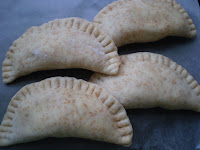 Today was Ukrainian Christmas Eve, and I spent it watching the re-run of the world juniors final and making feta bacon perogies. Yes, feta is Greek, but I have so much of it I had to take the chance to use some up. And no, Ukrainians don't eat meat on Christmas Eve, but I also have a whole slab of slightly over-salted bacon. Deal with it.
I tried a new dough recipe this time around, one gleaned from Michael Symon's restaurant Lola, as documented by Michael Ruhlman in Soul of a Chef. It goes like this:
- 3 cups sour cream
- 3/4 lbs butter
- 6 eggs
- 12 cups flour
I scaled mine down. After reading Ruhlman's book Ratio, I've been trying to convert all recipes to weights, and seeing if there's a simple ratio at their core. For the above recipe I get...
- 24oz sour cream
- 12oz butter
- 12oz eggs
- 60oz flour
...which means the Master Perogy Ratio is 5 parts flour : 1 part butter : 1 part eggs : 2 parts sour cream.
Besides feta and bacon, I also have homemade red wine in unholyabundance. A small part of the perogies are stuffed with potatoes that have been simmered in red wine. This was one of those experiments I knew would turn out either really well or really poorly. Ends up there's a reason that potatoes are never cooked in wine: acid makes fiber rigid and inhibits the gelatinization of starch. While the potatoes did cook, a hard skin formed on the outside of each piece. The food mill managed to separate these hard parts of potato and extrude a nice potato purée.
I thought the purée tasted amazing, the cooked wine adding a bit of tartness to contrast salty cheese and bacon. Plus it was purple, which is cool, although the symbolism is more appropriate for Easter than Christmas.
Despite my enthusiasm, the red wine-bacon-feta perogies received mixed reviews.
I finally used the rest of my turkey giblets, as well as some other Thanksgiving leftovers (frozen, of course.)
I simmered the turkey neck, heart, and bones with onion, carrots, celery, thyme, white wine, and water to make stock. The neck gave a lot of body to the stock. A lot. When I chilled some extra stock it solidified to a thick pudding. To the rest of my stock I added mirepoix, corn, and left-over turkey meat. I also threw in some Canada Goose wild rice, which was cooked in a separate pot (cooking rice in the same pot will leach starch which clouds the otherwise clear soup).
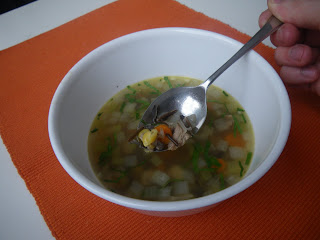
A good memory of Thanksgiving on a wintry day.
These days the best-known food from Quebec is smoked-meat, bagels, and poutine. These are undeniably important parts of Montreal's food scene, but are not as relevant to the rest of the province. Montreal gets its unique bagels and delicatessens from the large Jewish populations of the older neighbourhoods like Mile-End. Over the past few weeks I've been thinking about the winter food of a Quebecois farmstead (rather than the metropolitan dishes of Montreal). While tinkering with this idea I'll forgo the poutine italienne and look instead at dry-stored root vegetables and legumes, all manner of dairy, craft beer, maple syrup, and pork.
In Quebec, the pig is king. This is partly their cultural heritage: "For centuries pork was the most commonly consumed meat in rural France. Rare was the small farm without its own pig." (Robuchon). Pork also has an entire craft dedicated to its preservation (charcuterie), which is useful for rural winter-dwellers.
With this in mind, the first dish I made was cretons. Cretons is a pork spread, usually served on toast. Most cretons is made by simmering pork shoulder and aromatics in milk. Once the meat is tender enough, it is mixed until creamy and spreadable. It is very similar to the French rillette, which is pork shoulder simmer in stock, then mixed until spreadable. Cretons are usually eaten for breakfast. In making my own cretons I combined a rillette recipe from Rhulman's Charcuterie, and a recipe by Ron Eade, a food writer for the Ottawa citizen. I spliced these recipes together, replacing the stock with milk. Rillettes are traditionally sealed in ramekins with rendered fat. This is not traditional for creton, but it makes for such a fantastic presentation that I couldn't resist. Especially in winter, as the fat looks like a skating rink once it sets, and because with the addition of a sprig of rosemary and some peppercorns, you can imitate holly. (Ron Eade's idea.) Here's my variation:

Cretons
- 3 lbs pork shoulder, diced to one inch pieces
- 1/2 lb bacon
- 1/2 lb smoked ham hock
- 1 pork bone
- 1 bundle thyme
- 3 bay leaves
- 1 medium onion, roughly chopped
- 1 stalk celery, roughly chopped
- 4 peppercorns, tied into a cheesecloth bundle
- 1/8 teaspoon ground cloves (I didn't have whole cloves on hand, though those are probably to be preferred...)
- 1.25 L milk
First cover the diced shoulder with water and bring to a boil. This draws blood and impurities from the meat. Strain, discarding water. Place your purified shoulder and remaining ingredients in a large pot and cover with milk. Bring to a simmer, then place in 300F oven. Cook for 4 to 6 hours, until meat is falling-apart-tender.
Strain mixture, reserving liquid. Make sure you remove the bay leaves, peppercorn bundle, and pork bone. Place meat in standing mixer and mix on low speed, slowly adding reserve liquid until contents are moist and spreadable. This should take a couple of minutes.
Taste for seasoning. Since the dish will be served at room temperature, season assertively.
Some left-over ham got mixed with swiss cheese and mustard and baked in a pie crust.

 I picked up a monstrous hock from K&K Foodliner. It was one of the cheapest cuts of meat I have ever bought: about $6.50 for 1.7kg.
The plan was to convert this raw hock into a smoked ham hock, and then to use that to make a broth.
I put the hock in a simple brine solution for about a week, then smoked it over cherry wood.
I simmered my smoked ham hock for about an hour. The flavour was unbelievable. Obviously it tasted like pork, but it was so smoky it verged on campfire. If it were any warmer outside, or if I were serving the Queen high tea, I would have diluted it. But today it seemed right.
Next I used the broth to cook my vegetables. I actually used up the last of the carrots and potatoes from the fall harvest at Tipi Creek, (though we still have about a dozen squash and countless bags of frozen vegetables). Even after an aborted attempt at making sauerkraut, we also had lots of cabbage heads rolling about our refrigerator.
To recap, that was carrots, potatoes, and cabbage simmer in a ham hock broth. Garnished with shredded ham and celery leaves. Served with mustard and bread. A good cold-weather meal.

The term “barbecue” is used pretty loosely around these parts. Most often it refers to an outdoor grill, but I have also had “barbecued” items in restaurants that haven't been anywhere near an outdoor grill. In fact, these items, usually ribs or pulled-pork, have been braised or even stewed in an acidic solution called "barbecue sauce".
True barbecue is pork that has smoked at low temperature for several hours. The home of true barbecue is the American south, notably the Carolinas and Tennessee. When I say "true", I'm not arguing about the origin of the word or the antiquity of the practices, although I suspect that Southern barbecue would win on those fronts, too. I mean that the quality of the resulting product is infinitely superior with true barbecue. It is unlike any meat I have had before: it is transcendent.
The difference in taste is obvious. Complex, aromatic smoke is the base. Barbecue sauce is added towards the end of cooking, for a little acidity and sweetness. The real surprise was the texture. Food that is stewed in barbecue sauce is touted as "tender", but is actually just mushy. Food cooked low and slow and dry are tender, but they still have texture and bite.
In the southern states, there are barbecue restaurants. They have smokehouses where they cook pork ribs and beef briskets for eight hours. People line up to eat at these places. They literally go through tons of meat every day. They sell out of product every night. Occasionally one of these places will be featured on a Food Network show like Diners, Drive-In, and Dives. To my knowledge they just don't exist in Canada. Luckily you can do it at home.
Over the past two weeks I have barbecued twice. The first was with pork shoulder from Trowlesworthy Farms. The second was today, with grocery store side ribs, in the photo above.
Required Reading:
- Jeffrey Steingarten's essay "Going Whole Hog", from The Man Who Ate Everything. Does a good job describing the mania for barbecue in the southern states.
- Michael Ruhlman's recipes for Pulled Pork and Carolina Barbecue Sauce in his book Charcuterie.
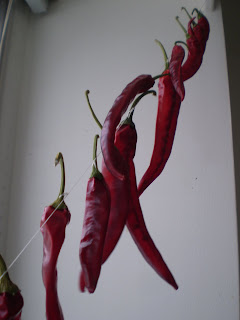 Or, How to Make Things Uncomfortable for a Microbe.
A simple start: dehydration. All life needs water, so removing the moisture from food makes it inhospitable to microbes. Some items can simply be air-dried. One week in July Lisa bought a whole bag of hot peppers from Doef's, then strung them together with unflavoured dental floss and hung them in our kitchen. The skin has become paper thing and brittle, and when held to the light you can see the shadows of the seeds. It's a simple preserving method that requires almost no work and keeps us in pepper heat all winter long.
You could probably also naturally air-dry fruit, but partway through the summer a family of fruit flies moved into our house, so we had to give our drying method a little boost. We had a couple gallons of saskatoons and tried a batch in the oven and a batch in a food dehydrator that Lisa and Judy found at a garage sale (one of several fantastic finds this summer.) Both turned out great and make a tasty addition to our infinite supply of granola.

 Today was Ukrainian Christmas Eve, and I spent it watching the re-run of the world juniors final and making feta bacon perogies. Yes, feta is Greek, but I have so much of it I had to take the chance to use some up. And no, Ukrainians don't eat meat on Christmas Eve, but I also have a whole slab of slightly over-salted bacon. Deal with it.


 Posts
Posts

